Tide Pool Biotope: A Dynamic Microcosm in the Aquarium
Introduction: life on the border between land and sea
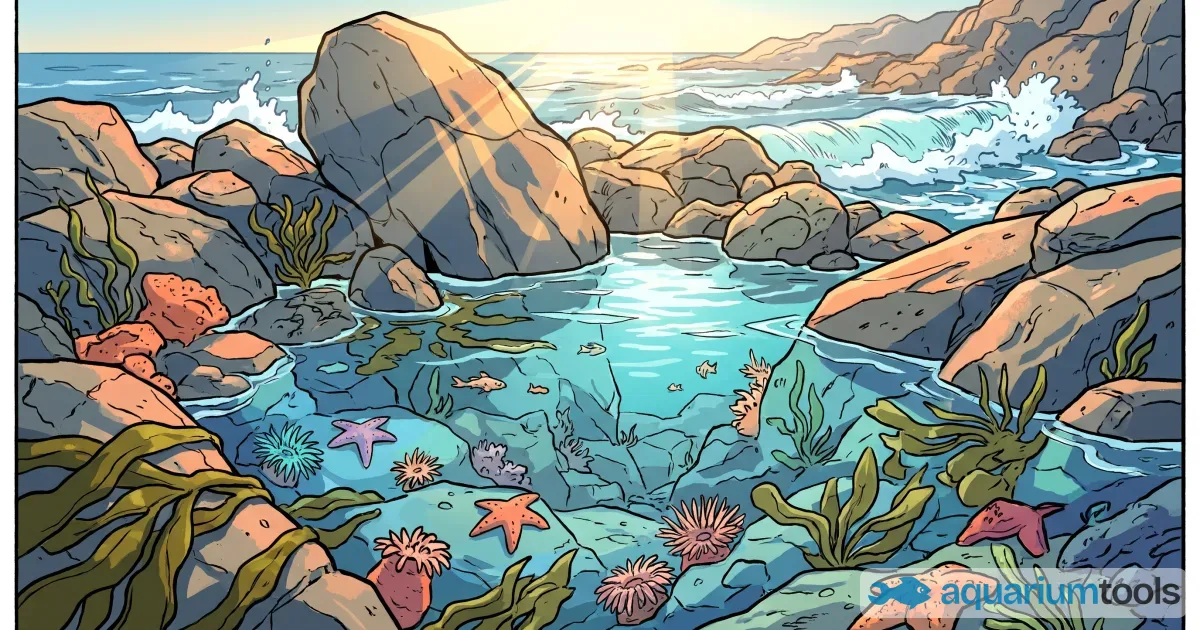
Tide pools, or rockpools, are among the most fascinating and underrated marine environments. Twice a day, with the rhythm of the tides, these small basins carved into the rock transform themselves: now connected to the open sea, now isolated under the sun or lashed by rain. In just a few hours the temperature can rise by several degrees, salinity can spike from evaporation or plummet from dilution, and oxygen fluctuates with the rhythm of photosynthesis. The organisms that thrive here are true athletes of physiological resilience.
It is precisely this harshness that makes the tide pool an ideal candidate for a marine nano-aquarium (or pico-reef) with character. Temperate and subtropical coastal fauna tolerate a far wider range of parameters than delicate tropical corals require, offering in return extremely high observational value: curious behaviours, territorial interactions and a resilience that forgives the small mistakes of the beginner.
Physiology and chemistry of an extreme environment
Understanding the tide pool means accepting variability as the rule, not as an emergency. In nature the daily temperature swing can exceed 10 °C, while salinity fluctuates significantly between daytime evaporation and freshwater inputs. In the aquarium we do not need to reproduce these extremes (they would be harmful in a small volume), but we can take inspiration from their dynamics by keeping values stable within a realistic window.
Oxygenation and water movement are crucial. In real pools the breaking waves continuously re-oxygenate and mix the water; in the tank this translates into good gas exchange at the surface and a lively but diffuse flow. Here are the recommended target parameters:
| Parameter | Recommended value |
|---|---|
| Salinity | 35-37 per thousand (SG 1.025-1.027) |
| Temperature | 18-24 °C (depending on geographic origin) |
| pH | 8.1-8.4 |
The choice of temperature depends on the reference biotope: a Mediterranean setup settles on the lower values, a subtropical one towards 24 °C. In summer a small fan or cooling fan helps to contain the peaks, which in nano-volumes are the greatest risk.
Layout and hardscape: building the reef in miniature
The aesthetic and functional goal is to recreate the complexity of intertidal rock. On the bottom you lay a substrate of aragonite sand or organogenic detritus with a medium-coarse grain size, enriched with a few smooth pebbles that recall the stones rounded by the waves.
The rockscaping is the heart of the project. Arranging live rock or structured synthetic rock so as to form crevices, caves, cracks and small staggered hollows creates the microenvironments that bottom-dwelling fish and crustaceans love. Always leave escape routes and multiple hiding places: in confined spaces they reduce stress and territorial aggression. Glue the rocks with aquarium-safe adhesive to prevent landslides.
The flora completes the picture and works for us. Well-structured macroalgae such as Ulva, Codium and Gracilaria, together with encrusting calcareous algae (corallines), stabilise nutrients by absorbing nitrates and phosphates, oxygenate and enrich the visual result. They are also a source of natural grazing for many inhabitants of the biotope.
Fauna selection and husbandry profiles
Shallow-water anemones
Intertidal anemones are ideal protagonists thanks to their extraordinary tolerance. Actinia equina (beadlet anemone) withstands even brief periods of emersion and strong variations in parameters. Anemonia viridis (synonym Anemonia sulcata), with its long tentacles, offers great visual dynamism. They should be placed on solid rock, where they can anchor themselves and choose their preferred position, and fed in a targeted way with small pieces of mussel, shrimp or other marine meats a couple of times a week.
Small crustaceans
The shrimps Palaemon elegans and Palaemon serratus are tireless scavengers and very pleasant to observe. Beware, however, of size: large adult specimens can bother or prey on fry and very small fish. Among the crabs, Pachygrapsus marmoratus and similar species of modest size bring great liveliness, but they are territorial and opportunistic: they should be introduced as single specimens or in very limited numbers, keeping an eye on the interactions.
Small benthic fish
The real stars of the show are the gobies and the blennies. Gobius paganellus and related species live clinging to the bottom and explore the crevices with curiosity. Among the blennies, Lipophrys pholis and Coryphoblennius galerita display amusing behaviours, strong personality and marked territoriality: better a single specimen per small tank, unless there is abundant space and hiding places.
Compatibility and safety
In nano-volumes coexistence must be calibrated carefully. Avoid large fish and delicate tropical corals, unsuited to these dynamics. Pair crustaceans and fish of similar size to prevent predation: a large shrimp and a newly born goby do not get along. Finally, an absolute rule: many blennies and almost all crabs are skilled escapers and climbers. A lid or an anti-escape containment rim is not an option, but an indispensable safety measure.
Practical guide to managing nano-volumes
The reduced water mass is both the charm and the challenge of this setup. Fewer litres mean faster fluctuations and less margin for error. The absolute priority is control of salinity: with evaporation, in a nano-volume the concentration rises quickly. An automatic top-off system (ATO) that replenishes with pure reverse-osmosis water is the most important tool of the entire system, because it keeps the level, and therefore the salinity, constant.
For filtration and movement, compact solutions are enough: a small hang-on-back filter ensures mechanical and biological filtration, while a wavemaker pump with a diffuse and gentle flow recreates the mixing of the pool without creating violent currents. Avoid direct and overly intense jets, which are unrealistic and stressful for the bottom-dwelling inhabitants.
The maintenance protocol must be regular and measured:
- Small weekly water changes (about 10-15 per cent) with quality marine salt, to dilute nutrients and replenish elements.
- Frequent removal of particulate matter and food residues, which in a few litres accumulate quickly.
- Careful management of the feeding load: little food and often, avoiding excesses that cause nitrates and phosphates to spike.
- Periodic checking of salinity, temperature and pH to catch any drift immediately.
Conclusion: a great show in a small space
The tide pool biotope demonstrates that you do not need large tanks or expensive species to obtain an aquarium rich in life and behaviours. In a few litres, with well-arranged rocks, hardy macroalgae and robust, carefully selected fauna, an authentic microcosm is enclosed that changes and surprises every day. By respecting the parameters, anti-escape safety and the discipline of maintenance, you will transform a small volume of water into a stage where intertidal nature puts on, in miniature, one of its most fascinating shows.
Keep reading
Fishless Reef Biotope: An Aquarium Dedicated to Corals and Invertebrates
A complete guide to setting up an Invert-Only reef: corals, anemones and crustaceans as the stars, with low biological maintenance, stability and macro details to discover.
Mediterranean biotope: recreating a posidonia meadow in your aquarium
A complete guide to setting up a temperate marine aquarium inspired by the posidonia meadow: parameters, hardscape, native fauna and respect for the regulations that protect Posidonia oceanica.
Caribbean Biotope: Corals and Fish of the Tropical Atlantic
A complete guide to recreating the Caribbean reef in your aquarium: swaying gorgonians, brain corals, Ricordea florida and iconic fish like the Gramma loreto, with a direct comparison to the Indo-Pacific reef.
All material on this site is protected by copyright. Partial or total copying and republishing without authorization is not allowed.
Comments
Join the conversation
Create a free account to leave a comment. It only takes a minute and you'll come right back here.
No comments yet. Be the first to share your experience.