Fishless Reef Biotope: An Aquarium Dedicated to Corals and Invertebrates
Introduction: the "Invert-Only" reef revolution
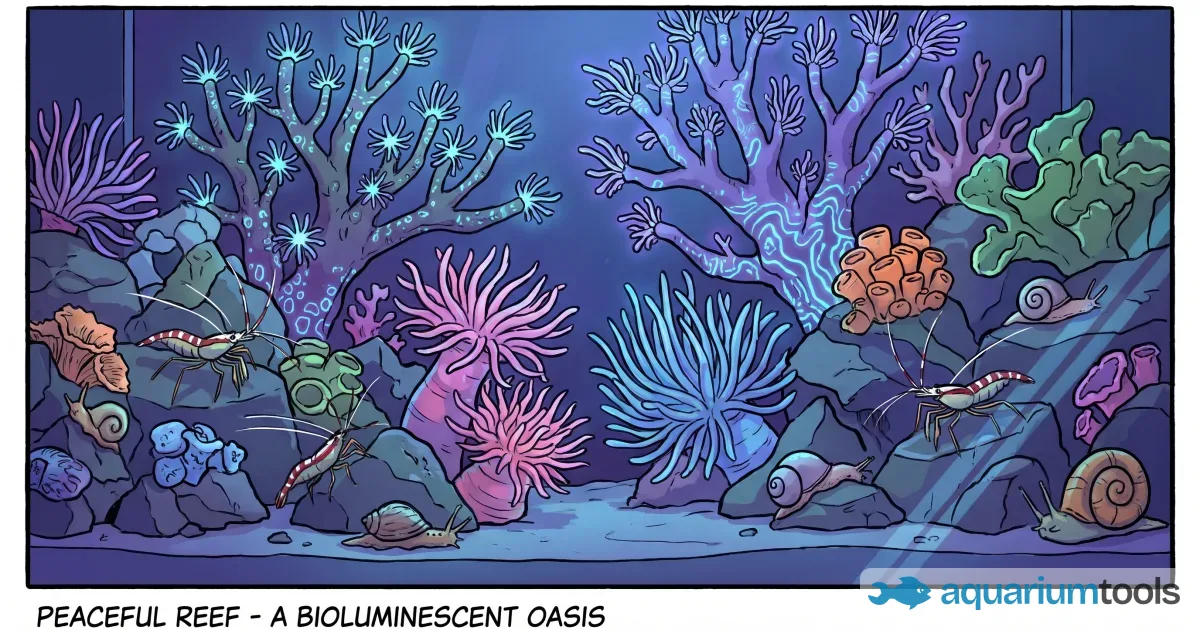
The classic reef tank almost always revolves around fish: vivid colours, movement, interaction with the viewer. There is, however, an alternative approach, increasingly appreciated by conscious aquarists, that flips the perspective: removing the fish component entirely in order to dedicate the tank exclusively to corals and invertebrates. This is the concept of the Invert-Only reef.
Without fish to capture your attention, the gaze shifts to the details: the slow extension of a Euphyllia's polyps, the dance of a cleaner shrimp, the tireless work of a snail on the glass. It is a microcosm on a macro scale, where behavioural dynamics of crustaceans, molluscs and cnidarians emerge, dynamics that would go unnoticed in a crowded tank.
The advantages of a fishless system: low maintenance and biological stability
Giving up fish brings concrete, measurable systemic benefits:
- A drastic reduction in organic load. Without fish metabolism and without the protein-rich foods intended for fish, the production of nitrogenous waste plummets.
- Simplified filtration. With less organic input, nitrate (NO₃) and phosphate (PO₄) levels stay naturally low, taking away the fuel for invasive algae.
- No predation on corals. The risks linked to grazing fish such as angels (family Pomacanthidae) or filefish disappear: the polyps stay extended even during the day, stress-free.
- Less frequent water changes. Greater stability allows you to reduce the volume and frequency of changes, though without eliminating them entirely.
Chemical-physical parameters and nutrient management
Stability remains the golden rule. These are the target reference values:
| Parameter | Recommended value |
|---|---|
| Salinity | 35 ppt (SG 1.025-1.026) |
| Temperature | 24-25 °C |
| pH | 8.1-8.4 |
| Calcium (Ca) | 420-450 mg/L |
| Carbonate hardness (KH) | 7-9 dKH |
| Magnesium (Mg) | 1300-1400 mg/L |
Calcium, KH and magnesium make up the trio essential for the calcification of hard corals and molluscs. They must be monitored regularly and replenished with the balling method or a calcium reactor in the more demanding tanks.
There is, however, a specific pitfall of fishless systems: the risk of water that is too clean. In ultra-low nutrient systems (ULNS), nitrates and phosphates can drop to zero, pushing corals into so-called starvation, with loss of colour and paling. The solution is not to pollute the tank, but to feed the corals directly: phytoplankton for filter feeders, zooplankton and specific preparations for LPS and SPS, amino acids dosed sparingly. The goal is to keep NO₃ and PO₄ low but detectable, never at zero.
Rockscaping and layout for invertebrates
Without fish to swim about, the hardscape can be designed entirely around the invertebrates. The ideal is to create two macro-zones:
- Terraces exposed to the light, in the upper and central area, for photosynthetic corals that depend on zooxanthellae.
- Caves and crevices in shade, in the lower area, for shade-loving fauna: shrimp, porcelain crabs and sponges that prefer the gloom.
For the substrate there are two philosophies. Fine or medium aragonite sand (DSB or a thin layer) favours the detritivorous microfauna - amphipods, copepods, spaghetti worms (genus Cirratulus and relatives) - creating a lively food web. The Bare Bottom approach, on the other hand, favours maximum cleanliness and the ease of removing detritus.
Fauna selection and compatibility
Corals and anemones
The palette is enormous. Among the soft corals and the so-called "zoas and mushrooms", Zoanthus sp., Ricordea sp. and the mushrooms of the genus Discosoma stand out. Among the LPS, great visual impact comes from Euphyllia sp. and Trachyphyllia geoffroyi. For those who want a symbiotic anemone, Entacmaea quadricolor is among the hardiest - while remembering that, without clownfish, it will not perform its host function but will still remain a fascinating subject.
Crustaceans and cleaner/symbiotic shrimp
This is where the Invert-Only reef shows its best. The cleaner shrimp Lysmata amboinensis and the fire-red Lysmata debelius are perfect protagonists. Symbiotic shrimp such as Ancylomenes pedersoni and various Periclimenes sp. live in association with anemones. The porcelain crab Neopetrolisthes maculatus, an elegant filter feeder, is also much appreciated. Among the hermits, Clibanarius tricolor and Paguristes cadenati are excellent scavengers.
Clean-up crew (CUC) and molluscs
For controlling algae and detritus, rely on gastropods such as Tectus sp., Astraea sp., Trochus sp. and, for sand and carcasses, the detritivorous Nassarius sp. In very well-lit tanks you can add the clams Tridacna crocea and Tridacna maxima, true photosynthetic jewels.
Beware of incompatibilities. Large hermit crabs can prey on gastropods to seize their shells: always provide spare empty shells. Some opportunistic hermits and crabs may also pick at anemones and corals. Observe them and, in case of predatory behaviour, step in.
Guide to feeding management and maintenance
In a fishless tank, food must be delivered in a targeted way. Shrimp and anemones readily accept small portions of Mysis, brine shrimp or shrimp meat offered directly with tweezers. Corals should be fed according to their nature: phytoplankton for clams and filter feeders, zooplankton preparations and micro-granulates for LPS and SPS, amino acids to support colouration.
The key point, worth repeating: a fishless aquarium still needs a controlled source of organic nourishment. Without a regular supply of nitrogen and phosphorus, corals waste away. Management does not consist of zeroing out the nutrients, but of dosing them precisely.
The maintenance protocol is deliberately streamlined:
- Weekly cleaning of the glass with a scraper or magnet.
- Regular testing of the trio (Ca, KH, Mg) and of NO₃/PO₄.
- Automatic top-off of evaporated water via an ATO to keep salinity constant.
- Reduced but scheduled water changes, to replenish trace elements.
Conclusion: the minimalist reef as a new frontier
The fishless reef is not a sacrifice, but a choice of focus. By eliminating the main source of organic load, you gain in biological stability and reduce the most burdensome maintenance, provided you understand that the system must still be fed intelligently. In return you get an intimate microcosm, where corals and invertebrates reveal behaviours and colours that would otherwise stay hidden. For the conscious aquarist, it is one of the most fascinating and sustainable frontiers of modern marine aquarium keeping.
Keep reading
Mediterranean biotope: recreating a posidonia meadow in your aquarium
A complete guide to setting up a temperate marine aquarium inspired by the posidonia meadow: parameters, hardscape, native fauna and respect for the regulations that protect Posidonia oceanica.
Caribbean Biotope: Corals and Fish of the Tropical Atlantic
A complete guide to recreating the Caribbean reef in your aquarium: swaying gorgonians, brain corals, Ricordea florida and iconic fish like the Gramma loreto, with a direct comparison to the Indo-Pacific reef.
Central American Biotope: Rocks, Sand and Charismatic Cichlids
A practical guide to setting up a biotope aquarium from Mexico and Central America: water parameters, hardscape, iconic species and temperament management.
All material on this site is protected by copyright. Partial or total copying and republishing without authorization is not allowed.
Comments
Join the conversation
Create a free account to leave a comment. It only takes a minute and you'll come right back here.
No comments yet. Be the first to share your experience.