Why aquarium water changes matter
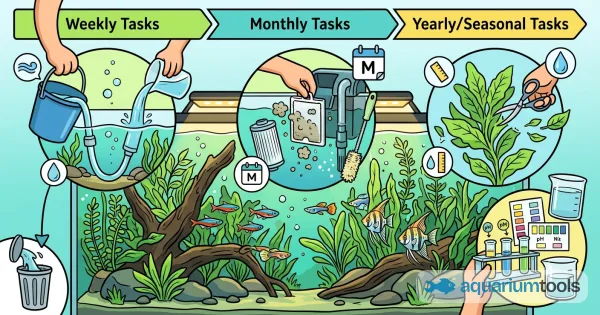
A water change does three things at once: removes nitrate and dissolved organics that filtration can't, restores minerals that plants and shrimp consume, and resets buffer capacity so pH stays where you want it. Skipping water changes is usually the cause of the slow decline that ends with someone asking why "everything is dying" in a Facebook group at 11 PM.
How much water to change, and how often
A short table is more useful than five paragraphs of caveats:
| Setup | Typical schedule | Why |
|---|---|---|
| Low-tech planted | 25% / 2 weeks | slow plant uptake, stable nitrate |
| High-tech / EI | 50% / week | resets dosed nutrients before they accumulate |
| Crystal / Bee shrimp | 10–15% / week | shrimp dislike rapid swings |
| Neocaridina / community | 20–25% / week | good balance |
| Goldfish, cichlids | 30–40% / week | heavy bioload, high nitrate |
| Quarantine / hospital | 25% / 2 days | fast turnover during treatment |
Remineralising RO/DI water
Reverse-osmosis water comes out of the membrane stripped - TDS of 0–5 ppm, no GH, no KH, no buffer. Putting that straight into a tank is worse than tap water for almost every fish. You need to add minerals back in two separate steps:
Step 1 – GH+ for hardness
"General hardness" (GH) is calcium + magnesium. Most freshwater fish want some – shrimp need it for moulting. Aim for 4–6 dGH for caridina, 6–10 dGH for neocaridina and community fish.
Step 2 – KH+ for buffer
"Carbonate hardness" (KH) is what keeps pH from swinging. Without it, CO₂ injection or fish respiration drives pH up and down dangerously. 2–4 dKH is plenty for shrimp and planted tanks; community tanks often run 4–8 dKH.
What TDS should I aim for?
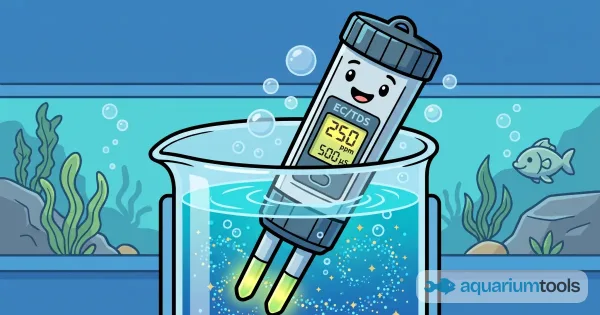
TDS - total dissolved solids - is a quick proxy for "how much stuff is in the water". After remineralising RO, expect TDS roughly equal to (GH dGH × 17) + (KH dKH × 17) + 30 ppm of trace minerals. The calculator does this for you.
- Crystal red shrimp – 100–150 ppm
- Neocaridina - 200–300 ppm
- Planted community – 150–250 ppm
- African cichlids – 350–500 ppm (separate salts; consult a Rift-Lake guide)
The boring but important part
Two practical tips that quietly determine whether your livestock notice the change:
- Match temperature within ~1 °C. A small heater in your changing bucket is the easiest way.
- Drip-acclimate the new water in over 20–30 minutes if your tank houses shrimp or wild-caught fish. A simple length of airline with a knot in it is enough.