Iwagumi vs Dutch: Two Aquascaping Philosophies Compared
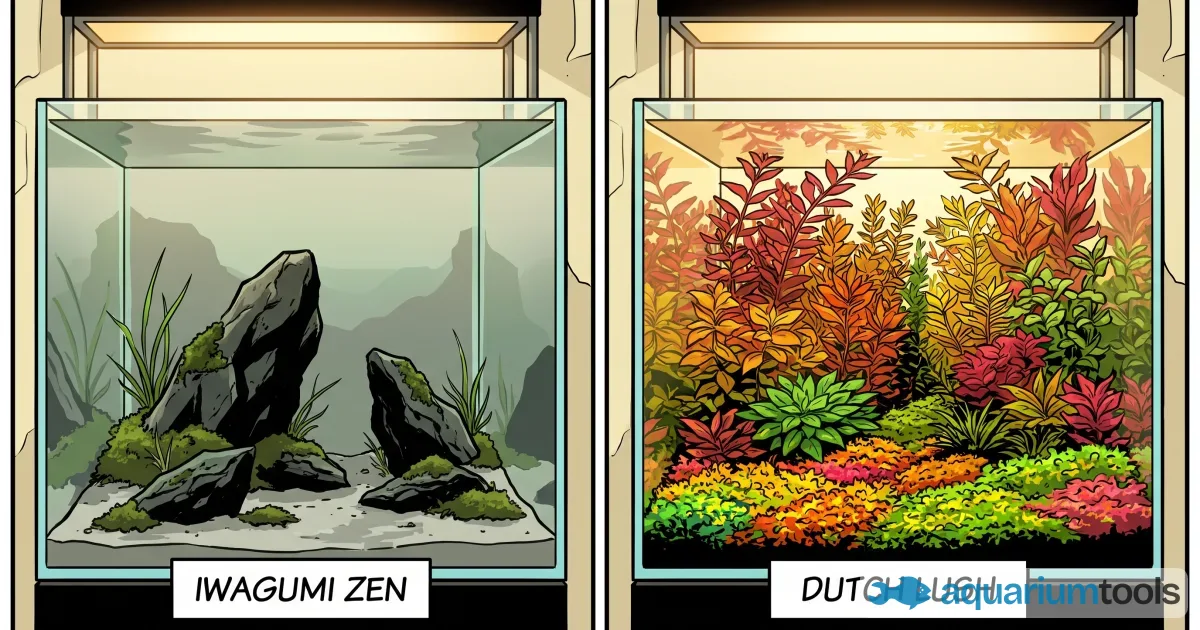
Aquascaping: when the aquarium becomes art
For a long time the aquarium was seen simply as a transparent container to house a few fish. Aquascaping completely overturned this view, transforming the tank into a genuine living work of art. Composition, perspective, chromatic balance and plant growth become the tools of an underwater artist who paints with rocks, wood and vegetation.
As in painting or gardening, aquascaping too has its movements and schools of thought. Two of the most celebrated and fascinating are the Iwagumi style, of Japanese inspiration, and the Dutch style, born in the heart of Europe. They represent two almost opposite philosophies: contemplative minimalism on one side, chromatic exuberance on the other. Let's explore them together.
The Iwagumi style: the essence of stone
The Japanese term Iwagumi literally means "rock formation". This style was made famous by Takashi Amano, the Japanese master considered the father of modern aquascaping, who in the 1990s brought Zen aesthetic principles and the concept of wabi-sabi, the beauty of imperfection and simplicity, into the aquarium world.
The rules of composition
Iwagumi is governed by precise rules and an almost mathematical rigor. The scene is built around the rocks, arranged in odd numbers (three, five, seven) to avoid symmetry and give a natural feel. Each stone has a well-defined role:
- Oyaishi: this is the main rock, the largest and most imposing. It is placed according to the golden ratio, slightly tilted, and represents the visual focal point of the entire composition.
- Fukuishi: these are the secondary rocks, placed on either side of the Oyaishi. They balance its presence without stealing the scene, supporting the overall harmony.
- Soeishi: these are the smallest, supporting stones, which complete the picture and add depth and a sense of continuity.
To achieve aesthetic coherence, rocks of the same type are used, such as Seiryu stone or Ohko stone, so that color and veining dialogue with one another.
Recommended plants and fish
The vegetation in Iwagumi is deliberately understated: few species, often just one, forming a uniform and orderly green carpet. Carpeting plants are the absolute protagonists, such as Eleocharis acicularis, Glossostigma elatinoides or Micranthemum "Monte Carlo". The carpet serves to enhance the rocks, not to compete with them.
As for the fauna, the ideal choice is a large school of small fish of the same species, which, swimming together, emphasize the open space and the sense of tranquility. Paracheirodon (neons and cardinals), Boraras or Microrasbora are perfect: their chromatic uniformity mirrors the minimalism of the style and creates a fluid, hypnotic movement.
The Dutch style: the submerged garden
If Iwagumi is meditation, the Dutch style is a celebration of plant life. Born in the Netherlands around the 1930s and codified by the NBAT (the Dutch aquarium association) in the following decades, this approach uses neither rocks nor wood: the scene is built exclusively with plants.
The underlying idea is that of a true submerged garden, a lush underwater parterre where each species is cultivated as in a botanical flower bed. Plant density is at its maximum, so much so that the substrate and the walls disappear beneath a mantle of leaves.
Terraces, contrasts and textures
The great mastery of the Dutch style lies in the arrangement. Plants are organized into descending terraces, with the shorter species in the foreground and the taller ones in the background, creating depth and perspective. A key element is the so-called Dutch streets, diagonal paths of plants that guide the eye toward the back of the tank.
The play of color is fundamental: sharp color contrasts alternate, pairing bright green with the intense red of species such as Alternanthera reineckii, Rotala and Ludwigia. Equally important are the textures: fine, feathery leaves are set against broad, fleshy ones, so that each group stands out clearly from its neighbor. A well-established principle recommends not filling more than a certain portion of the surface with the same species, in order to maintain variety and order.
The fauna, in this style, is secondary: small, discreet schools that animate the scene without distracting from the leading role of the plants.
Comparing the two styles
Before choosing, it is helpful to compare the two approaches from a technical and management standpoint. Both require attention, but with very different commitments.
| Parameter | Iwagumi | Dutch |
|---|---|---|
| Difficulty level | Medium-high (simple in form, difficult in balance) | High (requires botanical experience) |
| Maintenance | Medium: trimming the carpet and controlling algae | High: frequent and constant pruning |
| CO2 requirement | High: essential for a healthy carpet | High: essential for dense growth |
| Lighting | Intense and uniform | Intense, to enhance the colors |
| Number of plant species | Few, often just one | Many, even more than ten |
As you can see, the difference lies not so much in absolute technical difficulty as in the type of challenge. Iwagumi tests your sense of composition and self-control: with few elements, there is no room for error. The Dutch style, on the other hand, requires a deep knowledge of plants, their growth rhythms and their nutritional needs.
How to choose the right style for you
There is no single best style: there is the style best suited to your sensibility and your abilities. If you love simplicity, visual calm and the charm of stone, and you are willing to patiently tend a perfect carpet, Iwagumi will give you scenes of great elegance. It is also a good testing ground for those who want to learn to manage light and CO2 on a relatively controlled scene.
If instead you are passionate about gardening, thrilled by colors and unafraid of weekly pruning, the Dutch style will offer you a canvas in constant evolution, capable of transforming month after month into a riot of green and red.
A practical tip for beginners: start with tanks of manageable size, pay attention to fertilization, CO2 and lighting, and don't rush. Aquascaping is a journey, not a destination. Whichever path you choose, remember that true art is born from observing nature and from the patience to let it grow before your eyes.
All material on this site is protected by copyright. Partial or total copying and republishing without authorization is not allowed.
Comments
Join the conversation
Create a free account to leave a comment. It only takes a minute and you'll come right back here.
No comments yet. Be the first to share your experience.