Central American Biotope: Rocks, Sand and Charismatic Cichlids
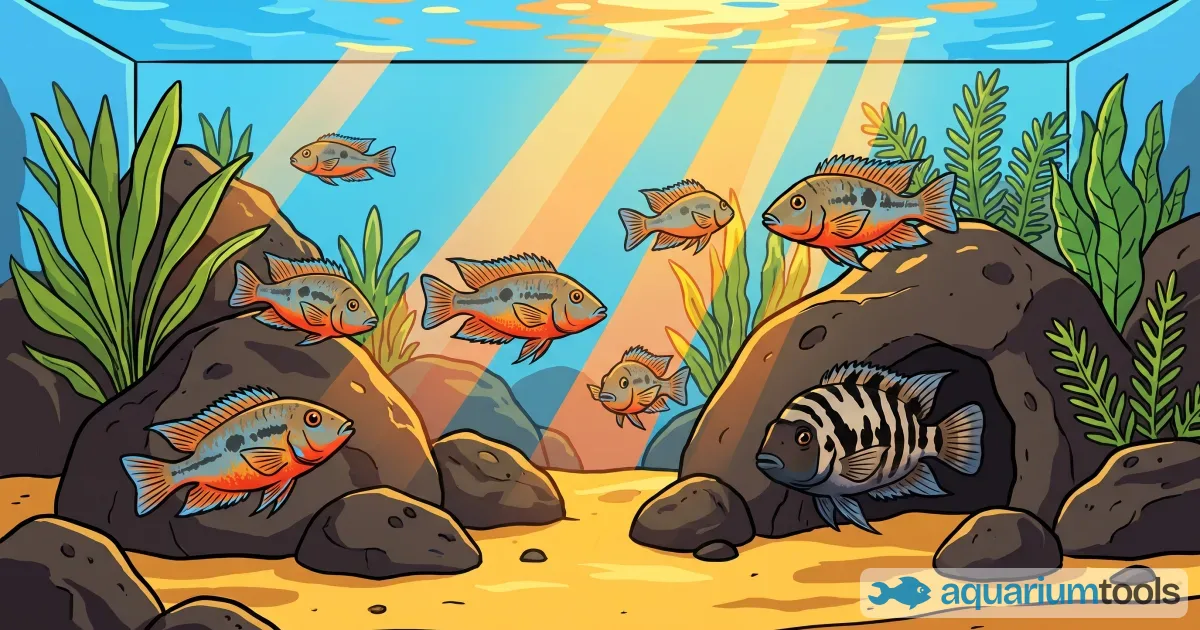
Central American habitats tell a story of contrasts: rivers with variable currents, calm pools and large volcanic lakes spread across Mexico, Guatemala, Nicaragua and Costa Rica. In these environments the water tends to be mineralized and the substrate alternates between sand, pebbles and smooth rocks. Recreating a Central American biotope means aiming for essential yet scenic layouts, dominated by stone and wood rather than dense planting.
The real star here is the behavior of the fish. Central American cichlids are animals with a strong temperament, with courtship rituals, territorial defense and parental care that turn the tank into a continuous spectacle. Designing this type of aquarium therefore requires careful planning: not only aesthetics, but concrete management of spaces and hierarchies. In this guide we look at parameters, decor, iconic species and tank dimensions to achieve a stable and rewarding environment.
Water parameters and physico-chemical management
Central American waters are on average hard and tend toward alkaline, very different from Amazonian ones. The reference values for a balanced biotope are:
- pH: from 7.2 to 8.2 (neutral to slightly alkaline)
- Total hardness (GH): 10-20 °dGH
- Carbonate hardness (KH): 8-15 °dKH
- Temperature: 24-28 °C, generally warmer than other tropical biotopes
A robust KH is a valuable ally: it acts as a buffer and prevents sudden swings in pH, which are particularly harmful in tanks with a heavy organic load. For this very reason it is advisable to keep values stable over time rather than chase "perfect" numbers.
Central American cichlids are fleshy fish and major producers of nitrogenous waste. The golden rule is oversized filtration: aim for external filters with a flow rate equal to 5-6 times the tank volume per hour. Combine this with regular, substantial water changes (25-30% per week) to keep nitrates and dissolved compounds under control. If your tap water is too soft, you can correct it with specific mineral salts or by adding calcareous materials such as limestone rocks or an aragonite-based substrate, useful for stabilizing KH and pH over time.
Layout and decor
The aesthetic of the Central American biotope is clean and textural. A few well-placed elements are enough to create a believable and functional environment.
Substrate
Opt for fine sand or rounded gravel. Many species love to dig, move the substrate and prepare spawning sites: sharp edges can damage gills and barbels. Sand also enhances colors and allows the fish to express natural behaviors.
Hardscape
Rocks and river pebbles are the heart of the setup. Use them to build piles, caves and visual barriers that define separate territories. It is essential to rest the rocks directly on the bottom glass, before the substrate, to avoid collapses caused by digging fish. Add smooth driftwood positioned naturally, as if it had been dragged along by the current, to complete the scene and offer additional shelters.
Vegetation
Plants are often optional or limited: cichlids tend to uproot or nibble them during the breeding phase. If you want a touch of green, choose robust and unappetizing species such as Vallisneria (which stands up well to hard water) or Anubias anchored to rocks and wood, where the roots cannot be disturbed. Avoid delicate stem plants: in this context they are short-lived.
The iconic fish
The selection of species is what makes a Central American biotope truly memorable. Here are the most representative stars.
Charismatic cichlids
Amatitlania nigrofasciata (Convict Cichlid). Perhaps the Central American cichlid par excellence: hardy, adaptable and with fascinating behavior. Its vertical bands earn it the name "convict". It is extremely territorial, especially during breeding, and offers exemplary parental care: both parents protect the eggs and fry with almost ferocious dedication. A pair can become dominant even in large tanks, so adequate space and boundaries must be provided.
Thorichthys meeki (Firemouth Cichlid). Elegant and with a more measured character than the Convict, it owes its name to a throat of intense fire red. Its most spectacular behavior is the threat display: it expands the throat sac and opens the gill covers to appear larger and intimidate rivals, often without resorting to physical contact. It is relatively tolerant and lives well in well-structured aquariums, provided it has its own territory to defend.
Poeciliids (livebearers)
Genus Xiphophorus (Platy and Swordtail, Xiphophorus helleri). These livebearers are not just decorative: in nature they share the same environments as cichlids and in the aquarium they play the role of dither fish ("decoy" or distractor fish). By swimming actively in the middle and upper zones, they give the cichlids a sense of security, reducing their shyness and, indirectly, their mutual aggression. They are hardy, thrive in hard and alkaline water and tolerate the higher temperatures of the biotope. However, they should be introduced in sufficient numbers, because a portion of the fry will inevitably be preyed upon.
Tank dimensions and temperament management
The success of this biotope depends as much on liters as on the available floor area. For a pair of cichlids with a small group of dither fish, consider a tank of at least 120-150 cm in length and 250-300 liters or more. The length of the bottom is often more important than the absolute volume: more horizontal space means more definable territories and fewer conflicts.
Managing aggression is a matter of space design. A smart arrangement of rocks, wood and visual barriers breaks up lines of sight: if a dominant fish does not constantly see its rivals, tension drops dramatically. So create clearly separated territories, with multiple caves and hiding spots, so that each specimen can retreat. Avoid overcrowding or, conversely, keeping too few specimens, situations that concentrate aggression on a single target. Always observe the group dynamics in the first few weeks and, if necessary, rearrange the hardscape to redistribute the balance.
Conclusion
The Central American biotope rewards those who seek dynamism, spectacular behaviors and hardy species. Between brightly colored threat displays, intense parental care and the lively comings and goings of the livebearers, this type of tank offers an observational experience rarely matched. The secret, however, lies entirely in the planning: adequate dimensions, stable parameters and a hardscape designed to manage hierarchies. Before buying the fish, carefully design the tank around their ethological needs: it will be the difference between a conflict-ridden aquarium and a balanced, rewarding ecosystem.
Keep reading

Aquarium Water Test: Strips or Liquid Reagent? Guide and Key Values
A complete guide to aquarium water tests: the 6 key values, the comparison between strips and liquid reagents, and the best kits for every budget.

Light in the freshwater aquarium: a guide to the perfect photoperiod
How light works in the aquarium, what Kelvin, colour rendering and intensity mean, and how to set a balanced photoperiod for healthy plants and fewer algae.
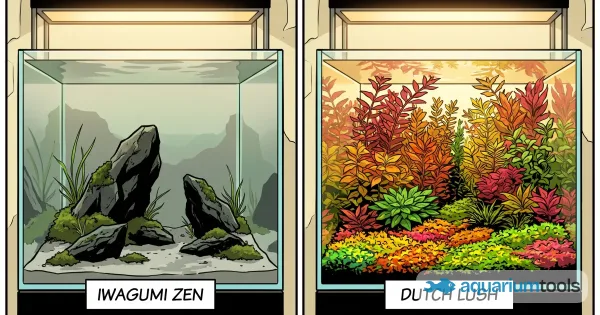
Iwagumi vs Dutch: Two Aquascaping Philosophies Compared
Discover the differences between the Iwagumi style and the Dutch style: history, compositional rules, plants, fish and a practical comparison to choose your ideal aquarium.
All material on this site is protected by copyright. Partial or total copying and republishing without authorization is not allowed.
Comments
Join the conversation
Create a free account to leave a comment. It only takes a minute and you'll come right back here.
No comments yet. Be the first to share your experience.