Light in the freshwater aquarium: a guide to the perfect photoperiod
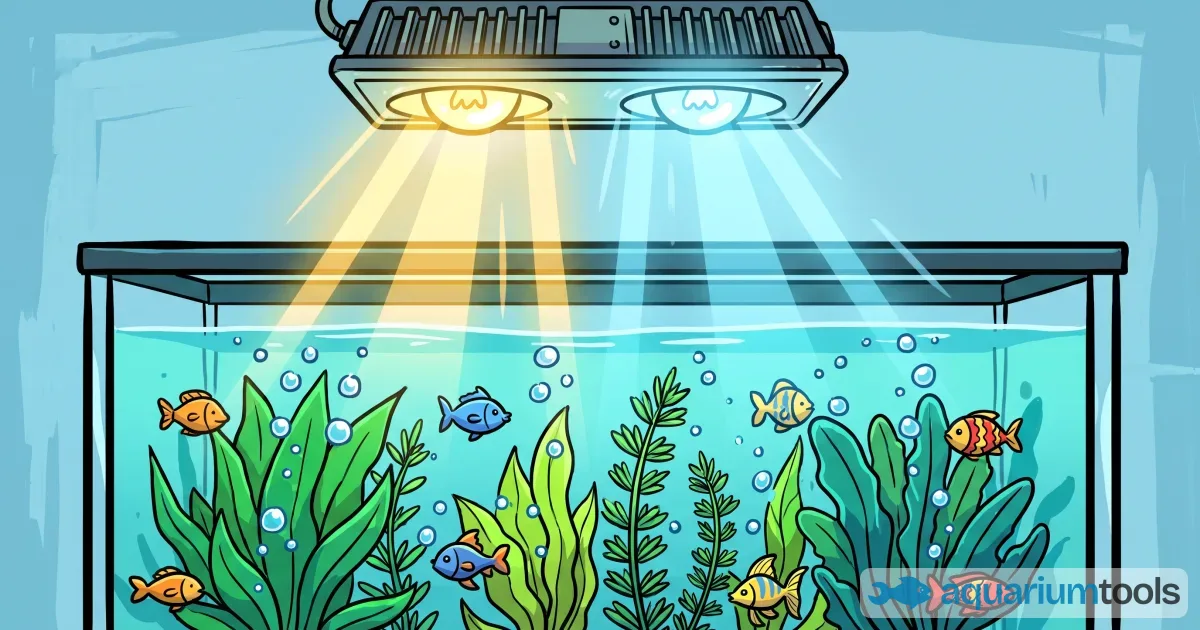
When we think about aquarium lighting, we often consider it merely a way to admire the colours of our fish. In reality, light is much more than that: it is the fuel for aquatic plant photosynthesis and the regulator of the biological clock of the entire ecosystem. Managing it correctly means having lush plants, fish with natural rhythms and, not least, effective control over algae. In this guide we analyse the fundamental parameters of light and how to build a balanced photoperiod.
The parameters of light: understanding what really matters
Not all lamps are the same. To choose and adjust your lighting you need three key concepts: spectrum, colour rendering and intensity.
The light spectrum (degrees Kelvin)
Colour temperature, measured in degrees Kelvin (K), describes the tone of the emitted light. Low values (around 3000 K) produce a warm, yellowish light; high values (above 10000 K) produce a cold, bluish light. For a planted freshwater aquarium, the most balanced range usually falls between 6500 and 8000 K: a light reminiscent of midday sunlight, pleasant to the eye and suitable for photosynthesis.
It should be noted that Kelvin indicates the perception of colour, not the actual composition of the spectrum. Plants mainly use red and blue wavelengths, so a good planted-tank lamp must contain both of these components, regardless of the perceived colour temperature.
Colour rendering (CRI)
The colour rendering index (CRI, from 0 to 100) measures how faithfully a light source reproduces the real colours of objects. A high CRI (above 90) makes the reds of plants and the colours of fish appear vivid and natural. It does not directly affect growth, but it greatly improves the aesthetic appearance of the tank.
Intensity (Lumens and PAR)
Intensity is the amount of light that actually reaches the water. A practical and widespread reference is the Lumens per litre ratio:
- Low-demand tank (easy plants, little light): about 20-30 lumens/litre.
- Medium tank: about 30-50 lumens/litre.
- High-demand tank (demanding plants, CO₂ and fertilisation): over 50 lumens/litre.
The most precise parameter, used by advanced hobbyists, is PAR (photosynthetically active radiation), which measures the light plants can actually use at a given depth. It should always be remembered that intensity drops rapidly with water depth: a tall tank requires more power than a shallow one with the same surface area.
Setting the photoperiod: how many hours of light are needed
The photoperiod is the daily duration of lighting. One of the most common beginner mistakes is keeping the lights on for too long, believing this helps the plants. In reality, beyond a certain threshold plants do not grow any more: the surplus light benefits algae.
The 8-10 hour rule is an excellent starting point for most freshwater aquariums. Beginners can start with 8 hours and increase gradually only if the plants grow well and the algae stay under control. Exceeding 10-11 continuous hours rarely brings benefits and often creates imbalances.
Gradual transitions: sunrise, sunset and moonlight
In nature, light does not switch on and off abruptly. Reproducing a gradual transition has concrete advantages for both the fish and the aesthetics:
- Sunrise effect: a progressive increase in intensity over 20-40 minutes reduces stress on the fish and avoids the "abrupt awakening".
- Sunset effect: the gradual decrease signals the arrival of night and prepares diurnal fish for rest.
- Moonlight: a faint bluish night-time light, at very low intensity, is mainly for scenic value. It should be used sparingly, because light that is too intense at night disturbs the animals' rest.
Most modern LED fixtures include timers and sunrise/sunset simulations: using them makes the tank's rhythm more natural and stable.
The midday break: myth or reality?
The so-called "midday break" involves dividing the photoperiod into two blocks (for example 4-5 hours in the morning, some hours of darkness, then another 4-5 hours) instead of a single continuous period.
The logic is as follows: algae react to the lights coming on more slowly than higher plants and, according to this theory, the interruption would prevent them from getting photosynthesis going. Higher plants, having energy reserves, would restart more easily after the break.
In practice the results are variable: the break is not a miracle solution, but in some tanks it helps to contain algae and has the practical advantage of illuminating the tank both in the morning and in the evening, when we observe it most. However, it does not solve an underlying problem: if the intensity is excessive or the tank is unbalanced, the break alone is not enough. It should be considered an accessory tool, not the cure.
Light and algae: when lighting becomes the problem
Algae are almost always the symptom of an imbalance, and light is one of the main factors. Let's look at the most frequent mistakes.
Too much light
This is the number one cause. Excessive intensity or too long a photoperiod provide energy in abundance. If the plants cannot consume all the available nutrients (due to a lack of CO₂ or fertilisers), the surplus of light and nutrients directly feeds the algae. The correct balance is the one between light, CO₂ and nutrients: unbalancing just one of the three factors opens the door to algae.
Too little light
The opposite deficiency is also harmful. With insufficient light, higher plants slow down or waste away, stop competing for nutrients and leave the field open to algae adapted to low light, such as the annoying brush algae and brown algae (diatoms).
Wrong spectrum or old lamps
An unsuitable spectrum or a source too weak in red and blue penalises the plants without discouraging the algae. Furthermore, fluorescent lamps degrade over time: after 12-18 months the spectrum shifts and the intensity drops, conditions that often favour algae. Quality LEDs maintain their performance longer, but they too should be assessed periodically.
Direct sunlight
The tank's position matters. A window that hits the aquarium directly introduces an uncontrollable and very intense source, a typical trigger for algal blooms. It is better to place the tank away from direct sunlight.
In summary: a balanced photoperiod
To build effective lighting, keep a few principles in mind:
- Choose a colour temperature between 6500 and 8000 K, with good red and blue content.
- Adapt the intensity to the real needs of your plants, avoiding excesses.
- Start with an 8-hour photoperiod, with gradual sunrise and sunset transitions.
- Try the midday break only as a supporting tool, not as a sole remedy.
- Remember that algae are a symptom: the real solution is the balance between light, CO₂ and nutrients.
Observe your tank consistently: growing plants and clean glass are the sign that your photoperiod is the right one. Fine-tuning is always a matter of small adjustments and patience.
Keep reading
Iwagumi vs Dutch: Two Aquascaping Philosophies Compared
Discover the differences between the Iwagumi style and the Dutch style: history, compositional rules, plants, fish and a practical comparison to choose your ideal aquarium.
Conductivity Meter (EC and TDS Meter): What It Is, How It Works and Which to Choose
A complete guide to the conductivity meter: what it is, the difference between EC and TDS, its applications, the importance of ATC and calibration, with a buying guide across three price ranges.
All material on this site is protected by copyright. Partial or total copying and republishing without authorization is not allowed.
Comments
Join the conversation
Create a free account to leave a comment. It only takes a minute and you'll come right back here.
No comments yet. Be the first to share your experience.