Brackish Biotope: Recreating a Mangrove in Your Aquarium
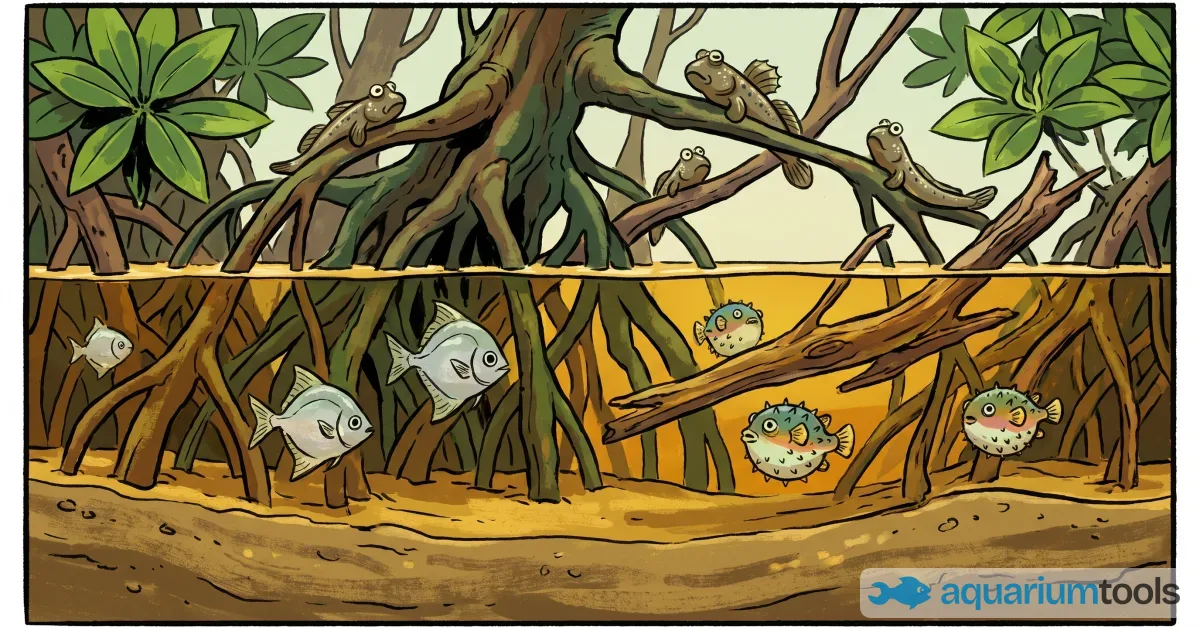
Introduction: the transitional ecosystem
Estuaries and mangrove forests represent one of the most fascinating and unjustly neglected frontiers of the aquarium hobby. These are transitional environments, where the river meets the sea and salinity fluctuates with the tides, seasonal rains and evaporation. The result is a dynamic ecosystem, populated by extraordinarily adaptable euryhaline organisms, capable of tolerating swings that would kill most stenohaline fish.
Compared to the classic freshwater aquarium or the reef, the brackish biotope has an almost perverse appeal: it requires mastering intermediate parameters, unstable by nature, and accepting a less glossy but deeply authentic aesthetic. Tangled roots, tannin-amber water, muddy sands and fish with marked behaviour turn the tank into a window onto a borderland world. This guide is aimed at intermediate-to-advanced aquarists, already comfortable with the nitrogen cycle and parameter management.
Water chemistry and salinity management
Brackish water occupies the middle band between fresh and marine. In the aquarium you typically work with a specific gravity (SG) between 1.005 and 1.015, roughly equivalent to a salinity of 7-22 g/l. The exact value depends on the species kept and the estuary zone you intend to reproduce: the bands closest to the sea require higher salinity, the riverine ones lower values.
To prepare the water, use exclusively synthetic marine salt specific for aquariums, the same used in marine setups. Never use table salt, iodised salt or generic mineral supplements: they lack the correct elements, contain anti-caking additives and do not guarantee a physiological ionic ratio. Dissolve the salt in RO water, stir until completely dissolved and measure only at a stabilised temperature.
For measurement, the swing-needle hydrometer is cheap but imprecise and sensitive to temperature and air bubbles; the refractometer, although more expensive, offers markedly more reliable readings and should be calibrated periodically with distilled water. Precision matters because in these volumes every deviation counts.
Managing fluctuations is the heart of the method. Evaporation increases salinity by leaving the salt in the tank: top-ups must always be done with RO water only, never with already salted water. Water changes, on the other hand, reintroduce salt: prepare them at the same SG as the tank to avoid swings. Monitor salinity regularly, ideally every day in small volumes.
The nitrogen cycle also works in brackish conditions, but the nitrifying bacterial community is sensitive to rapid salinity variations. Gradual changes allow the bacteria to adapt; abrupt changes can cause spikes of ammonia and nitrite. Mature the tank with patience and modify salinity in small increments over time.
Setup, layout and decor
The ideal substrate reproduces the soft bottoms of estuaries: fine or medium grain sands, possibly mixed with muddy or clayey fractions in paludarium tanks, where the emersed section anchors the roots. In purely aquatic tanks it is preferable to use a sand that is easy to siphon, to avoid anaerobic accumulations.
The structural backbone is wood. The roots of real Rhizophora mangle offer maximum realism and the possibility of cultivating live mangroves; alternatively you can use resin reproductions or suitable wood species stable in brackish water. Avoid woods that release excessive acidifying substances if you want to maintain stable parameters.
The botany requires attention. Live mangroves (propagules of Rhizophora mangle) must be kept with the prop roots submerged and the canopy emersed, under intense lighting. A crucial feature: many mangroves expel salt through their leaves, which must be periodically washed with fresh water to remove the salt crusts. Do not expect them to purify the water on their own: they grow slowly and their value is above all aesthetic and biotopic.
For vegetation tolerant of low salinity you can try Cryptocoryne ciliata, a robust marsh species, and Microsorum pteropus in the "Narrow" variety only at very low salinity. At higher salinities vascular plants suffer and it is better to focus on structural elements and suitable algae.
Fauna selection and husbandry profiles
The fauna determines the type of setup. Clearly distinguish amphibious species from strictly aquatic ones.
Periophthalmus spp. (mudskippers)
Periophthalmus are amphibious fish that spend much of their time out of the water. They require an aqua-terrarium or paludarium with a large emersed section: beaches, roots and surfaces to climb on, along with a shallow film of water at moderate salinity. They are territorial and need high humidity and a cover that prevents escape. They feed on small invertebrates and meaty prey.
Monodactylus spp.
Monodactylus argenteus and Monodactylus sebae are active schooling fish of large size as adults, requiring very spacious tanks. A key point: as juveniles they tolerate low salinity, but as they grow they must be gradually brought towards more marine values. They should be kept in a group to reduce social stress and need open space for swimming.
Brackish tetraodontiforms
Colomesus asellus, Dichotomyctere nigroviridis (formerly Tetraodon nigroviridis) and Tetraodon fluviatilis are fascinating but demanding pufferfish. They often show strong intraspecific aggression and should be assessed individually or in carefully designed setups. Their teeth grow continuously: the diet must include molluscs and shelled prey (snails, mussels) to ensure proper tooth wear. Compatibility with other fish is limited.
Invertebrates and support fauna
Among invertebrates, snails of the genus Neritina are adaptable to brackish conditions and useful against algae. In paludarium tanks with an emersed section you can add intertidal crabs such as Sesarma or Uca, which however require dry areas and should be assessed for potential predation and escape ability.
Warnings and management challenges
The main enemy of the brackish biotope is the instability of parameters in small volumes. The smaller the tank, the more rapidly evaporation and organic load cause salinity and nitrogen compounds to fluctuate. Always favour generous volumes: they offer greater chemical inertia and margin for error.
In closed tanks and paludariums the management of humidity and aeration is delicate. Amphibious species need humid air but also air exchange, to avoid stagnant condensation and respiratory problems. Provide adequate air circulation and clean emersed surfaces.
Finally, intraspecific compatibility and feeding aggression must be planned in advance. Many brackish species are territorial or predatory: study the population, numerical ratios and growth times before buying, avoiding forced cohabitations that lead to stress and losses.
Conclusion
Setting up a mangrove biotope means accepting the challenge of an ecosystem that is unstable by nature and turning it into managed balance. The result rewards you with an unusual aquarium, educationally rich and deeply evocative. There is also a conservation value: real mangroves are among the most threatened habitats on the planet, irreplaceable nurseries for countless species. Rebuilding a portion of one in a tank, with scientific rigour and respect for the animals, is a way to tell the story of and give value to a borderland world that is often forgotten, combining authentic aesthetics with responsible fishkeeping.
Keep reading
Central American Biotope: Rocks, Sand and Charismatic Cichlids
A practical guide to setting up a biotope aquarium from Mexico and Central America: water parameters, hardscape, iconic species and temperament management.
Lake Tanganyika biotope: sand, shells and unusual cichlids
A guide to the Lake Tanganyika biotope: alkaline, hard water parameters, typical rock and shell setups, and the fascinating behaviour of Shell Dweller cichlids.
European Stream Biotope: Setting Up an Aquarium With Native Fish
An uncommon yet fascinating approach: recreating a European stream in an aquarium with fresh, well-oxygenated water and often overlooked native species. Here's how to set it up correctly and in compliance with regulations.
All material on this site is protected by copyright. Partial or total copying and republishing without authorization is not allowed.
Comments
Join the conversation
Create a free account to leave a comment. It only takes a minute and you'll come right back here.
No comments yet. Be the first to share your experience.