Amazonian whitewater biotope: an ecosystem different from the Rio Negro
Introduction: the Amazon is not all the same
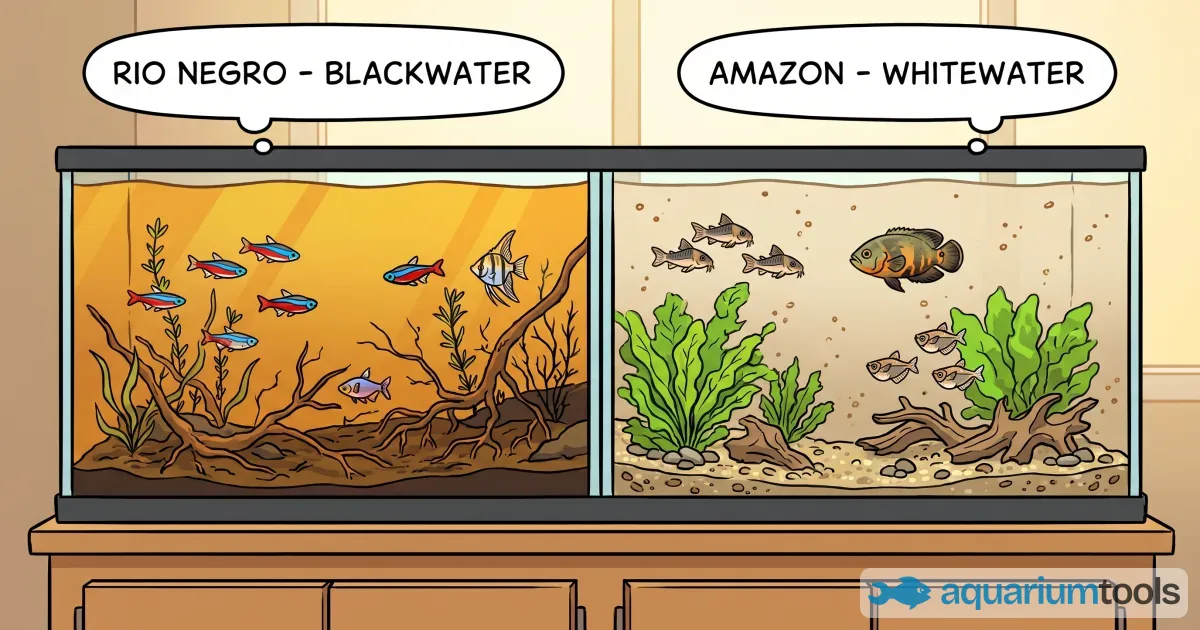
When people talk about the Amazonian biotope, many aquarists immediately picture blackwater: amber-coloured water, clear as tea, acidic and extremely poor in salts, typical of the famous Rio Negro. Yet the Amazon Basin is a true mosaic of ecosystems that differ profoundly from one another. Alongside the blackwaters there are the whitewaters (whitewater, agua blanca), which characterise the main course of the Amazon River, the Rio Solimões and the Rio Madeira.
These are two opposing worlds: where blackwater is clear but hostile to plant life, whitewater is turbid but extraordinarily fertile. Understanding this difference is the first step towards recreating a coherent and thoughtful biotope in the tank.
What is whitewater? Chemistry, physics and geological origin
The term "whitewater" can be misleading: it does not refer to a pure white colour, but to water with a milky or café-au-lait appearance, dense with particulate matter. The origin is geological. These rivers rise on the slopes of the Andes, young mountains subject to strong erosion, and along their course they carry an impressive load of mineral sediments, silt and suspended particles.
This explains their distinctive characteristics:
- High turbidity: light penetration is limited to a few decimetres.
- Higher conductivity, a sign of a fair amount of dissolved mineral salts.
- Medium mineral content, with a constant supply of nutrients.
- Neutral or moderately shifted pH, generally between 6.5 and 7.5.
The contrast with blackwater is sharp: the latter is extremely acidic (pH 4.0 - 5.5), loaded with tannins and humic substances derived from leaf decomposition, and almost devoid of dissolved mineral salts.
Direct comparison: whitewater vs blackwater
The following table summarises the main differences between the two biotopes, useful for guiding setup choices.
| Parameter | Whitewater (Rio Solimões, Madeira) | Blackwater (Rio Negro) |
|---|---|---|
| River origin | Andean range, strong erosion | Guiana Shield, sandy and ancient soils |
| Transparency and colour | Turbid, milky, café-au-lait coloured | Clear but amber, tea-coloured |
| pH | 6.5 - 7.5 | 4.0 - 5.5 |
| Conductivity and hardness | Medium, mineral salts present | Very low, very soft water |
| Light penetration | Poor (suspended particulate) | Good (clear water) |
| Submerged vegetation | Rich and lush | Scarce or absent |
Layout and setup of the biotope in the aquarium
Recreating whitewater does not mean keeping the tank constantly turbid, but reproducing its ecological logic: fertile substrates, current and an abundance of nutrients.
Substrate
Forget the pure white silica sand typical of blackwaters. Here you need a substrate that recalls erosive sediments: fine sand mixed with inert silty or clay components. A richer substrate encourages rooting plants to take hold and reproduces the nutritious mud of river beds.
Decor and hardscape
The backbone of the layout is provided by intricate roots, submerged logs and branches, often accompanied by accumulations of leaf litter. These elements create nooks, shaded areas and precious refuges for the bottom-dwelling fauna, as well as offering surfaces for the development of biofilm.
Flora and botanicals
This is where whitewater shows all its difference. Thanks to the constant supply of dissolved nutrients and mineral salts, the vegetation is decidedly richer than in the Rio Negro, where chemical poverty and extreme acidity make plant life difficult. In the whitewater biotope there is room for submerged plants such as Echinodorus and Helanthium, as well as floating plants such as Pistia stratiotes and Eichhornia spp. These floating plants, besides being typical of fertile Amazonian environments, help to filter the light, recreating the natural half-shade.
Fauna selection and care profiles
The choice of inhabitants must respect eco-geographical consistency. It is important not to introduce species typical of blackwaters, such as Paracheirodon axelrodi (Cardinal tetra, endemic to the Rio Negro and the Orinoco), except in confluence zones that would justify it.
Corydoras spp.
The Corydoras are protagonists of the sandy, silty bottom. Species such as Corydoras julii, Corydoras trilineatus and Corydoras sterbai are benthic fish that sift the substrate in search of food. They should always be kept in large groups (at least 6-8 specimens), on a soft bottom that will not damage their barbels.
Loricariidae
Armoured catfish, such as Ancistrus spp. and Hypostomus spp., are perfectly adapted to these environments. Many species are detritivorous or xylophagous and draw nourishment from the biofilm and detritus that accumulate on wood and roots. They tolerate a good current well, a characteristic typical of the large whitewater rivers.
Schooling characins
For the central and upper part of the water column, dynamic characins such as Hyphessobrycon spp., Moenkhausia spp. and Astyanax spp. are ideal. They are active fish, tireless swimmers, that appreciate tanks with good circulation and moderate lighting. These too should be kept in a school to reduce stress and bring out their natural behaviours.
Cohabitation and water quality
The cohabitation of Corydoras on the bottom, loricariids on the roots and characins in open water reproduces the natural stratification of the biotope. The load of sediment and particulate, however, requires enhanced mechanical filtration, capable of handling the suspended particles without compromising the functional clarity of the tank. Good water movement, moreover, recreates the current typical of these rivers.
Conclusion and management tips
The whitewater biotope offers concrete advantages over extreme blackwaters. The greater pH stability, kept in a neutral or moderately acidic range, makes management simpler and less prone to sudden crashes. The presence of mineral salts also makes plant cultivation easier, turning the aquarium into a living, lush environment, unlike the technical challenge that blackwater tanks represent.
Beyond the practical aspects, setting up a whitewater biotope is above all an exercise in geographical awareness. Recognising that the Amazon is not a single habitat, but a collection of distinct ecosystems, means doing aquascaping with respect and competence, choosing substrate, plants and fish that truly live together in nature. It is this consistency that transforms a simple tank into a faithful fragment of the great river.
Keep reading
Brackish Biotope: Recreating a Mangrove in Your Aquarium
A technical guide to designing and managing a mangrove and estuary biotope aquarium: salinity chemistry, setup, botany and informed selection of brackish fauna.
Central American Biotope: Rocks, Sand and Charismatic Cichlids
A practical guide to setting up a biotope aquarium from Mexico and Central America: water parameters, hardscape, iconic species and temperament management.

Cloudy white haze in the aquarium: why it appears and what to do
Milky water in the first weeks after setup scares many beginners, but it is almost always a normal bacterial bloom. Here is what to do, what to avoid and when to really worry.
All material on this site is protected by copyright. Partial or total copying and republishing without authorization is not allowed.
Comments
Join the conversation
Create a free account to leave a comment. It only takes a minute and you'll come right back here.
No comments yet. Be the first to share your experience.