Cloudy white haze in the aquarium: why it appears and what to do
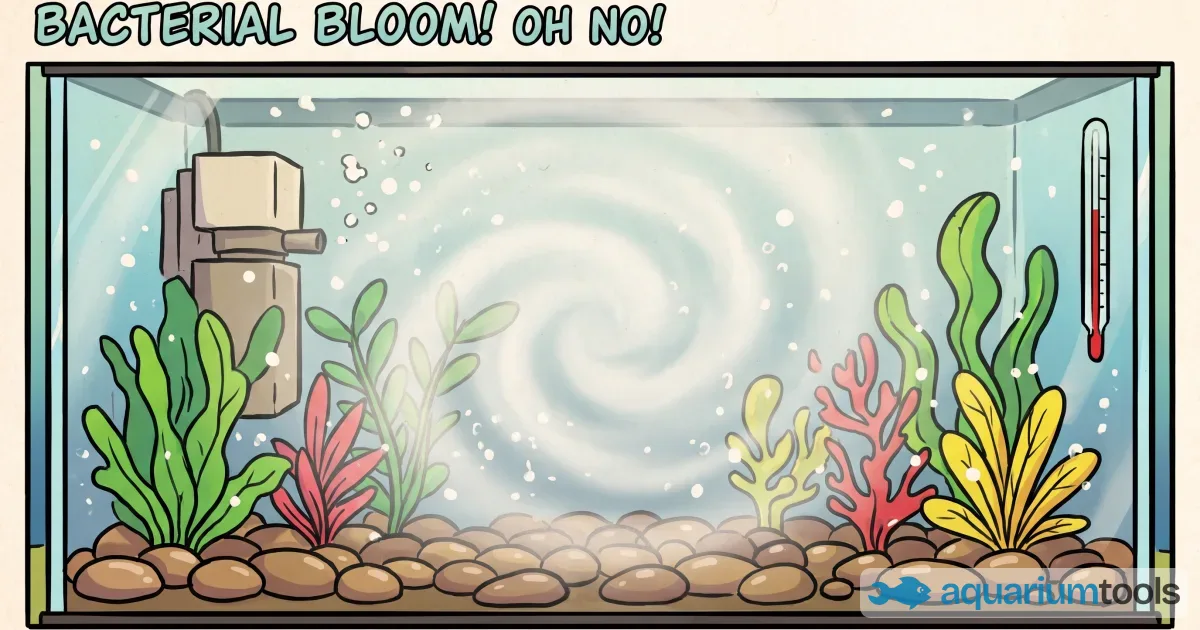
You set up your aquarium a few days ago, everything seemed perfect, and suddenly the water has turned milky, murky, almost as if diluted with milk. This is the moment when many beginners panic and rush to react with massive water changes or chemical products. Take a breath: in the vast majority of cases this phenomenon is completely normal, temporary and even a good sign. It means that microbiological life is taking shape in your aquarium.
In this guide I'll explain what really happens in the water, what the causes are, what to do (little) and above all what not to do so you don't slow down the maturation of the tank.
What is the white haze really?
The cloudy white haze typical of the start-up phase is a bacterial explosion, known in English as a bacterial bloom. In practice, billions of bacteria multiply so rapidly that they remain suspended in the water and make it cloudy. It is not dirt in the usual sense of the word: it is microscopic life in full activity.
To understand what is happening, you need to distinguish two large families of bacteria:
- Heterotrophic bacteria: these are responsible for the haze. They feed on organic matter (residues, dissolved nutrients, decomposing material) and reproduce extremely quickly. When there is plenty of food they explode in number, clouding the water. Then, once resources are exhausted, their numbers collapse and the water becomes clear again.
- Autotrophic (nitrifying) bacteria: these are the ones that colonise the filter and transform ammonia into nitrites and then into nitrates. They are much slower to settle in and reproduce: this is precisely why complete maturation takes weeks.
The haze, therefore, is almost always a sign that the delicate nitrogen cycle is getting underway. It is a transitional phase toward biological balance, not a mistake.
The main causes
The bacterial bloom doesn't arise from nothing: it needs nourishment. Here is where it usually comes from:
- Excess nutrients present in tap water or released by a freshly installed nutrient-rich substrate.
- Decomposing organic material: rotting plant leaves, roots and wood that release substances, food residues (if you started feeding too early).
- Bacterial starters dosed to speed up the start-up: paradoxically, by adding bacteria and nourishment they can trigger or accentuate the initial haze.
- Temporary lack of biological balance: until the nitrifying bacteria are numerous, the heterotrophs have free rein.
What TO DO: the practical guide
1. Patience, the number one remedy
In most cases the haze resolves on its own within a span ranging from a few days to 1-2 weeks. When the heterotrophs run out of readily available food, their numbers drop and the water becomes crystal clear again. Not intervening is often the best choice.
2. Maintain good oxygenation
The bacterial explosion consumes a lot of oxygen. Make sure the water surface is well agitated by the filter or add an air pump. Good oxygenation helps both the beneficial bacteria and the overall balance of the tank.
3. Monitor the water values
If you have already added organisms (something not recommended at this stage), keep an eye on ammonia (NH3/NH4), nitrites (NO2) and nitrates (NO3) with a reagent test. In a tank that is only maturing, without fish, monitoring mainly serves to understand how far along the nitrogen cycle is.
What NOT TO DO: the most common mistakes
This is where the difference is decided between a calm start-up and weeks of problems. Avoid these panic-driven mistakes:
- DON'T do massive water changes. It seems like the instinctive solution, but by removing water and reintroducing new nutrients you only risk feeding the heterotrophic bacteria even more and slowing down maturation. At most, if really necessary, do small partial changes.
- DON'T wash or dismantle the filter. The first precious colonies of nitrifying bacteria are forming in the filter media: cleaning them now would mean wiping out the work done and lengthening the timeline.
- DON'T use clarifiers or flocculants blindly. These products aggregate the particles and make the water look clear to the eye, but they do not solve the biological cause: they mask the symptom while the system is still immature.
- DON'T add fish. During the bloom the oxygen drops and, above all, this phase often precedes the nitrite (NO2) peak, which is highly toxic. Adding fish now means exposing them to potentially lethal conditions.
If you decide to do a small change, do it sensibly
During start-up, water changes should be measured, not improvised. If you want to calculate the right amount of water to replace based on the actual volume of your tank, you can use our calc_water_change calculator: it helps you set up a measured partial change, avoiding excessive replacements that would slow down maturation.
When to really worry?
Not all cloudy water is the same. Learning to distinguish the types of cloudiness tells you whether you can relax or whether a different action is needed:
- White/milky haze (bacteria): this is the bacterial bloom described in this guide. Typical of start-up, it resolves with patience.
- Greenish haze (single-celled algae): the water takes on a green tint, like green water. It is linked to an excess of light and nutrients, not to the normal start-up cycle, and requires a different approach (reducing light and nutrients).
- Mechanical dust (sand or gravel): fine particles in suspension due to a substrate that wasn't rinsed well before insertion. In this case the water is cloudy but not milky, and the mechanical filter clears it within a few hours or days.
A real warning sign, on the other hand, is the presence of persistent bad odours combined with cloudiness: they may indicate an excess of rotting organic material that needs to be removed manually.
In summary: the checklist
- Don't panic: white haze during start-up is normal and temporary.
- Wait: from a few days to 1-2 weeks and the water clears on its own.
- Oxygenate the tank well during the bloom.
- Don't do massive changes and don't touch the filter.
- No clarifiers blindly and no fish until the cycle is complete.
- Monitor the values to understand how far along maturation is.
Frequently asked questions
How long does white haze last in a new aquarium?
Generally from a few days to a couple of weeks. If it persists for a long time or reappears after disappearing, check for excess organic material or overfeeding.
Can I speed up the disappearance of the cloudy water?
The healthiest way is to ensure good oxygenation and let the bacteria work. Avoid chemical shortcuts that only mask the problem.
Is it dangerous for the fish?
The bloom itself consumes oxygen and often precedes the nitrite peak. For this reason, during the start-up phase fish should not be added until the nitrogen cycle is complete.
Conclusion
The cloudy white haze of the first few days is not a problem to fight, but a natural phase in the birth of your ecosystem. The best tool you have is not a product in a bottle, but time and patience. Let the tank find its balance, observe without intervening too much and, when needed, rely on measured water changes and constant monitoring of the values. The water will become crystal clear again, and this time on solid biological foundations.
Keep reading
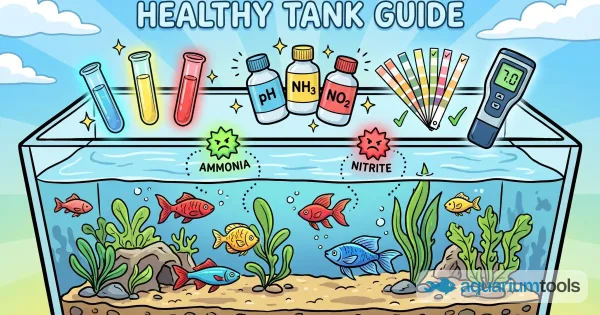
Aquarium Water Test: Strips or Liquid Reagent? Guide and Key Values
A complete guide to aquarium water tests: the 6 key values, the comparison between strips and liquid reagents, and the best kits for every budget.
All material on this site is protected by copyright. Partial or total copying and republishing without authorization is not allowed.
Comments
Join the conversation
Create a free account to leave a comment. It only takes a minute and you'll come right back here.
No comments yet. Be the first to share your experience.