Pierre Brichard and the Discovery of Lake Tanganyika Cichlids
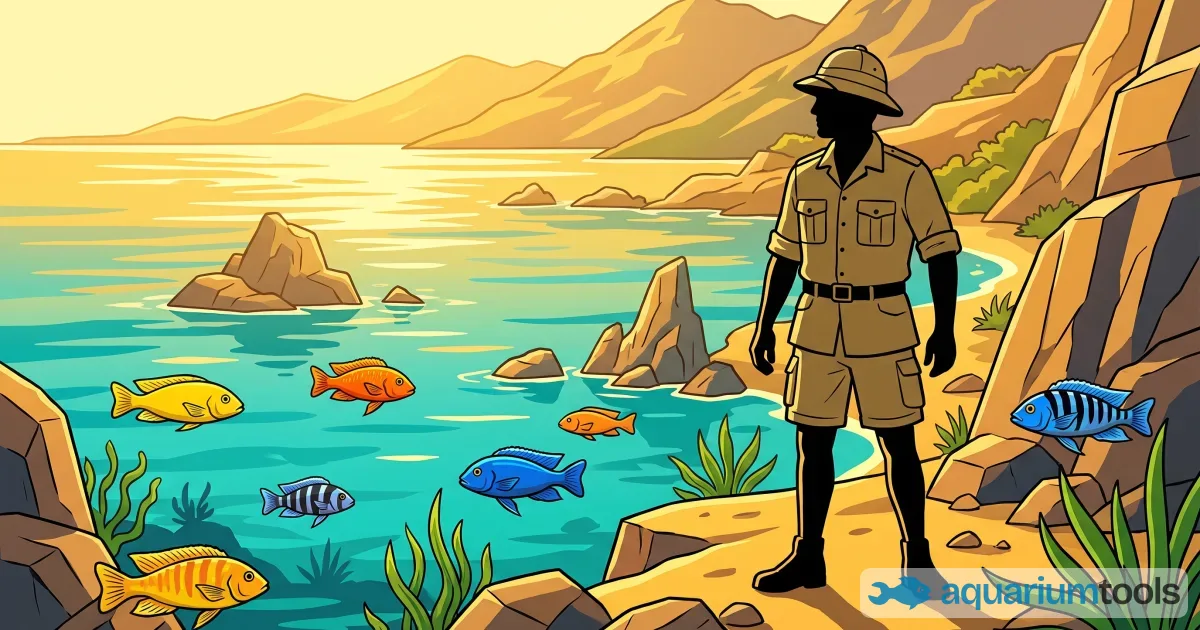
There are places that seem made to spark a naturalist's curiosity, and Lake Tanganyika is one of them. Ancient, deep and rich in species that exist nowhere else on Earth, this vast basin in East Africa has represented for decades one of the most fascinating frontiers of ichthyology. Among the people who helped make it known to aquarists all over the world, one name often recurs with respect: Pierre Brichard.
A Belgian on the shores of Tanganyika
Pierre Brichard was a naturalist and explorer of Belgian origin who chose to settle on the northern shores of Lake Tanganyika, in the region of Bujumbura, in Burundi. From that privileged position he devoted much of his life to observing, collecting and studying the lake's fish, with a particular focus on cichlids, the group that makes Tanganyika famous throughout the world.
His approach combined two souls that rarely coexist: that of the passionate observer of nature, capable of spending hours documenting behaviours and habitats, and that of the practical organiser, able to turn field knowledge into a structured export operation. It was precisely this combination that made him such an influential figure in the aquarium hobby of the second half of the twentieth century.
Exploring to understand, collecting to make known
Lake Tanganyika is not a simple environment. Its shores alternate between rocky bottoms, sandy expanses and transitional zones, each populated by different and highly specialised fish communities. Many Tanganyikan cichlids are tied to precise microhabitats: some live among the crevices of the rocks, others on sandy bottoms, and still others have developed surprising adaptations, such as laying their eggs inside empty shells.
Brichard explored these environments at length, often diving to observe the fish in their natural context. This fieldwork allowed him to understand not only the appearance of the species, but also their needs: the structure of the substrate, the depth, and their social and reproductive behaviours. For the aquarium hobby this was precious information, because keeping fish so tied to their environment in a tank requires recreating at least part of those conditions.
His collecting and exporting activity, developed from Burundi, became one of the main channels through which Tanganyika cichlids reached European and North American enthusiasts. Thanks to this work, species until then known almost only to specialists began to appear in the tanks of an ever-growing number of hobbyists.
The fish that won over aquarists
Among the Tanganyikan cichlids that became popular in the hobby, many are tied precisely to the period when the lake began to be explored and made accessible to the aquarium market. One of the most iconic is the small, elegant and slender cichlid scientifically described as Neolamprologus brichardi, whose specific name pays homage to Brichard himself. Known among enthusiasts by common names linked to Burundi, it has become a true gateway into the world of Tanganyika cichlids, appreciated for its delicate colouration and the fascinating social structure of its colonies.
Around this fish, and many others, an entire branch of the aquarium hobby dedicated to Lake Tanganyika has been built over time: tanks set up with rocks and shells, attention to the typically alkaline and hard water values, and the pursuit of reproducing complex behaviours in captivity. Much of this aquarium culture has its roots in the work of the pioneers who, like Brichard, made these fish known to the wider public.
The publications: from the lakeshore to the bookshelf
Pierre Brichard's legacy is not limited to the fish he exported. A fundamental part of his contribution comes through his books, into which he poured the experience accumulated over years of observation. His works dedicated to the fish of Lake Tanganyika, published in a popular science context and distributed internationally, served for a long time as a reference both for aquarists and for those approaching the study of this extraordinary ecosystem.
These volumes had the merit of combining species descriptions, information about habitats and practical guidance derived from direct experience. In an era when finding reliable data on Tanganyika cichlids was anything but easy, they offered an organic and accessible overview. Even today they are remembered as texts that helped shape entire generations of enthusiasts and spread a more informed knowledge of these fish.
A legacy that continues
The value of figures like Brichard should also be read in the light of today's sensibilities. The richness of Lake Tanganyika is at once a marvel and a responsibility: many species have restricted ranges and are vulnerable to environmental pressures. Knowing the habitats, as those who explored the lake first-hand did, is today the basis for promoting a more mindful aquarium hobby, one that favours captive breeding and the sustainability of collections.
Anyone who sets up a Tanganyikan aquarium today, with its layered rocks and shells on the sandy bottom, is in a sense taking up the baton of that work of discovery. Behind a group of Neolamprologus swimming compactly among the crevices lies a long history made of dives, patient observations and pages written to share knowledge.
Pierre Brichard thus remains a bridging figure between natural science and aquarium passion: an explorer who was able to translate the hidden life of an African lake into shared knowledge, helping to bring Tanganyika cichlids into the homes and hearts of enthusiasts in every corner of the world.
Sources
The information reported in this article has been verified by cross-referencing popular science and reference sources on the ichthyology of Lake Tanganyika and on African cichlids. Among the references useful for further reading:
- Encyclopaedic and reference entries on Neolamprologus brichardi and on the cichlids of Lake Tanganyika (Wikipedia, in Italian and English).
- Reference ichthyological databases such as FishBase, for the nomenclature and data on Tanganyikan species.
- Popular science works dedicated to the fish of Lake Tanganyika published by Pierre Brichard, considered reference texts by enthusiasts.
- Materials and articles from associations and aquarium magazines specialising in African cichlids.
Where biographical data could not be confirmed with certainty by several independent sources, we chose to stay at a general level so as not to report unverified information.
Keep reading
Oliver Knott: German Aquascaping Between Art and Technique
A portrait of Oliver Knott, one of the most recognised German aquascapers: a personal style, spectacular layouts and an intense teaching activity that has helped spread aquascaping across Europe.
Christel Kasselmann: the botanist who mapped aquarium plants
A portrait of Christel Kasselmann, German botanist and author of the reference work on aquarium plants: her fieldwork, her books and her legacy for the hobby.
George Farmer: aquascaper and educator between past and present
A portrait of George Farmer, the British aquascaper known for his planted aquariums and his intense educational work spanning magazines, videos and workshops. A profile covering style, community and educational content.
All material on this site is protected by copyright. Partial or total copying and republishing without authorization is not allowed.
Comments
Join the conversation
Create a free account to leave a comment. It only takes a minute and you'll come right back here.
No comments yet. Be the first to share your experience.