Oliver Knott: German Aquascaping Between Art and Technique
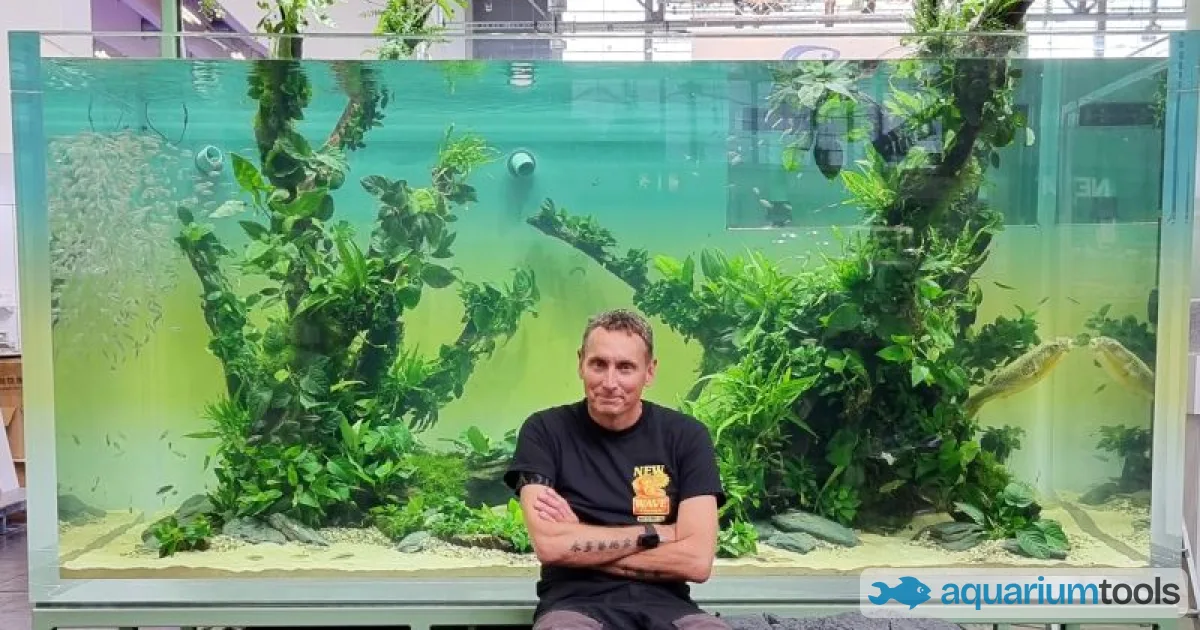
When aquascaping in Europe comes up, the name Oliver Knott appears quite naturally. One of the best-known German aquascapers in the international community, Knott has built a reputation founded on two pillars that rarely coexist with such balance: artistic sensitivity and technical rigour. His layouts are not only beautiful to look at, but they convey a way of understanding the aquarium as a living work, in constant transformation.
From a simple aquarium to a vocation
Like many enthusiasts, Oliver Knott approached the aquatic world starting from a personal interest that, over time, became a profession and a field of research. The shift from managing a home tank to designing complex underwater landscapes marked the beginning of a journey in which the creative component took on an ever greater weight. It was no longer just about keeping plants and fish healthy, but about composing scenes, giving depth and rhythm to the space, suggesting a natural environment through a few well-chosen elements.
This evolution progressively led him to work on an increasingly larger scale, up to creating large installations and presenting himself as a professional figure in the sector, between design, live demonstrations and educational activity.
A recognisable style
Oliver Knott's distinctive trait lies in his ability to combine spectacle and readability. His works tend to be immediately understandable to the eye: the scene has a clear focal point, the lines guide the gaze, the vegetation creates soft volumes that contrast with the more rigid structure of rocks and wood.
Some elements recur in his way of working:
- Scenographic composition. Knott is not afraid of high-impact layouts, capable of working even in public settings and on large-format tanks, where the visual effect must hold up from a distance.
- Use of depth. The management of planes, with larger elements in the foreground and details that fade into the background, is a constant that gives his scenes room to breathe.
- Controlled naturalness. Although inspired by nature, his layouts maintain precise direction: nothing appears random, yet the result does not look artificial.
- Attention to growth. An aquascape is not a fixed photograph; Knott designs while thinking about how the plants will evolve, anticipating how the tank will look over time.
This approach places him within a tradition that owes much to the nature aquarium school spread worldwide, but which Knott has reinterpreted with a personal signature, often more direct and communicative.
The competitive dimension
Modern aquascaping also thrives on international competitions, where enthusiasts compare their layouts through standardised photographs assessed by qualified juries. Oliver Knott is a well-known presence in this ecosystem, both as a participant and as a public face of the discipline.
More than the result of any single contest, his contribution is measured by the way he has helped bring these events to a wide audience. His live demonstrations, held at trade fairs and industry events, have introduced many spectators to the idea that behind a successful tank there is design work comparable to that of a gardener or a set designer.
Competitive aquascaping is not an end in itself: it is a tool for raising the bar, sharing ideas and pushing every enthusiast to look at their own tank with a more critical and ambitious eye.
The educator: outreach and teaching
If there is one aspect that makes Oliver Knott an influential figure beyond the individual layouts, it is his teaching vocation. Through workshops, public demonstrations and content shared online, he has made his own method available, explaining compositional choices, techniques for placing rocks and wood, plant management and step-by-step setup.
This training work has had a multiplier effect. Many European enthusiasts took their first steps by watching how a professional tackles a hardscape, how he balances empty spaces, how he hides the equipment to let the landscape take centre stage. Outreach, in this sense, is perhaps his most concrete legacy: not so much the individual tanks, but the skills passed on to an entire generation of aquascapers.
The contribution to the European scene
The spread of aquascaping in Europe is the result of many converging energies: clubs, forums, specialist shops, manufacturers and educational figures. Within this mosaic, Knott has played a bridging role, bringing a coherent and recognisable visual language into different settings and helping to make aquascaping a credible discipline even in the eyes of those outside the sector.
His presence at events and trade fairs has helped normalise the idea of the aquarium as an object of design and personal expression, shifting the centre of gravity from simple technical maintenance towards a more creative and cultural dimension.
What to learn from his approach
Even without aiming for spectacular layouts, anyone can draw inspiration from the method that Oliver Knott has made popular. Some useful principles:
- Plan before filling. Define the focal point, lines and proportions before adding water and plants.
- Think about growth. Choose species based on how they will alter the scene in the following months.
- Less visible equipment, more landscape. Hide tubes and gear so as not to break the natural illusion.
- Observe and correct. A mature aquascape is the fruit of pruning, adjustments and patience.
Oliver Knott's story reminds us that aquascaping lives in the meeting of two worlds: the technique that keeps an ecosystem in balance and the art that gives it a soul. And it is precisely in this balance, more than in any trophy, that lies the inspiration he continues to offer to anyone who looks at a tank and sees in it a small possible landscape.
Sources
The information in this article is based on public references regarding the figure and work of Oliver Knott. To learn more and verify updated data, we recommend consulting directly:
- Oliver Knott's official website and channels dedicated to his aquascaping projects and workshops.
- International aquascaping platforms and communities that document contests and layouts.
- Specialist aquarium-keeping magazines and portals that cover industry events and trade fairs in Europe.
Since awards, dates and collaborations may vary or be updated over time, we encourage you to compare several reliable sources before citing specific results.
Keep reading

Pierre Brichard and the Discovery of Lake Tanganyika Cichlids
The story of Pierre Brichard, the Belgian naturalist and explorer who brought Lake Tanganyika cichlids into the global aquarium hobby, through fieldwork, exports and books that became references for the hobby.
Christel Kasselmann: the botanist who mapped aquarium plants
A portrait of Christel Kasselmann, German botanist and author of the reference work on aquarium plants: her fieldwork, her books and her legacy for the hobby.
George Farmer: aquascaper and educator between past and present
A portrait of George Farmer, the British aquascaper known for his planted aquariums and his intense educational work spanning magazines, videos and workshops. A profile covering style, community and educational content.
All material on this site is protected by copyright. Partial or total copying and republishing without authorization is not allowed.
Comments
Join the conversation
Create a free account to leave a comment. It only takes a minute and you'll come right back here.
No comments yet. Be the first to share your experience.