Why aquarium water changes matter
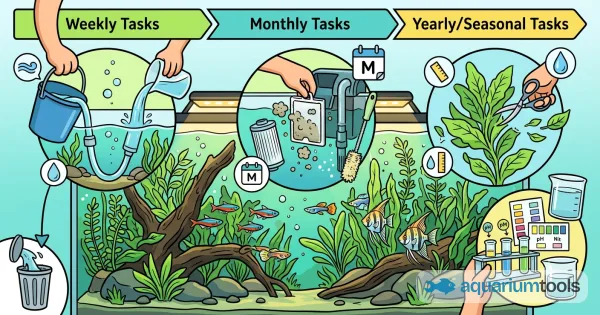
Uma mudança de água faz três coisas em simultâneo: remove nitratos e matéria orgânica dissolvida que a filtragem não consegue eliminar, repõe os minerais que as plantas e os camarões consomem e restabelece o efeito tampão para que o pH se mantenha estável. Não fazer mudanças de água é quase sempre a causa do declínio gradual que termina com alguém a perguntar num grupo do Facebook às 23h porque é que "está tudo a morrer".
How much water to change, and how often
A short table is more useful than five paragraphs of caveats:
| Setup | Typical schedule | Why |
|---|---|---|
| Low-tech planted | 25% / 2 weeks | slow plant uptake, stable nitrate |
| High-tech / EI | 50% / week | resets dosed nutrients before they accumulate |
| Crystal / Bee shrimp | 10–15% / week | shrimp dislike rapid swings |
| Neocaridina / community | 20–25% / week | good balance |
| Goldfish, cichlids | 30–40% / week | heavy bioload, high nitrate |
| Quarantine / hospital | 25% / 2 days | fast turnover during treatment |
Remineralising RO/DI water
Reverse-osmosis water comes out of the membrane stripped - TDS of 0–5 ppm, no GH, no KH, no buffer. Putting that straight into a tank is worse than tap water for almost every fish. You need to add minerals back in two separate steps:
Step 1 – GH+ for hardness
A "dureza total" (GH) corresponde ao cálcio + magnésio. A maioria dos peixes de água doce precisa de alguma – os camarões necessitam dela para a muda da casca. Aponte para 4–6 dGH para Caridina e 6–10 dGH para Neocaridina e peixes comunitários.
Step 2 – KH+ for buffer
A "dureza carbonatada" (KH) é o que impede as variações bruscas de pH. Sem ela, a injeção de CO₂ ou a respiração dos peixes faz oscilar perigosamente o pH. 2–4 dKH é suficiente para camarões e aquários plantados; os aquários comunitários funcionam frequentemente com 4–8 dKH.
What TDS should I aim for?
TDS - total dissolved solids - is a quick proxy for "how much stuff is in the water". After remineralising RO, expect TDS roughly equal to (GH dGH × 17) + (KH dKH × 17) + 30 ppm of trace minerals. The calculator does this for you.
- Camarões Crystal Red – 100–150 ppm
- Neocaridina – 200–300 ppm
- Comunitário plantado – 150–250 ppm
- Ciclídeos africanos – 350–500 ppm (sais separados; consulte um guia dos lagos do Rift)
The boring but important part
Two practical tips that quietly determine whether your livestock notice the change:
- Iguale a temperatura com uma margem de ~1 °C. Um pequeno termóstato no balde da mudança é a forma mais fácil.
- Faça a aclimatação gota a gota da nova água ao longo de 20–30 minutos se o seu aquário tiver camarões ou peixes selvagens. Um simples pedaço de tubo de ar com um nó é suficiente.