Guide to Real Plants vs Fake Plants
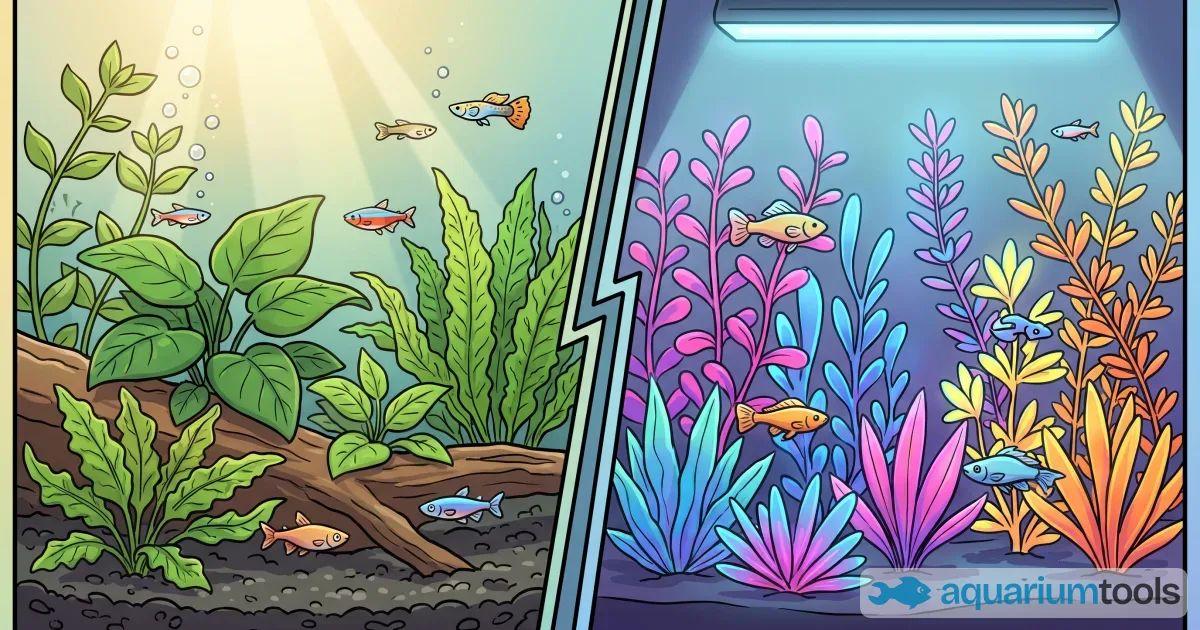
Choosing between real plants and artificial plants is one of the first dilemmas every aquarist faces when setting up a tank. There is no one-size-fits-all answer: the decision depends on the time you can dedicate to maintenance, your budget, the type of fish you keep and the aesthetic effect you want to achieve. In this guide we compare the pros and cons of both solutions, with a section dedicated to the easiest real plants to grow and a final summary table.
The benefits of real plants
Live plants are not just a decorative element: they actively take part in the biological balance of the aquarium and can make water management more stable over time.
Water oxygenation
During the day, in the presence of light, plants carry out photosynthesis and release oxygen into the water, contributing to the well-being of fish and microorganisms. It should be remembered that at night the process reverses and plants consume oxygen, so in heavily planted and well-populated tanks supplementary aeration can be useful.
Absorption of nitrates and nutrients
Plants use nitrogen compounds and phosphates as nutrients to grow. In this way they help limit the build-up of nitrates, the end products of the nitrogen cycle, indirectly reducing the pollutant load and supplementing (without entirely replacing) the work of the filter and water changes.
A natural habitat for fish
Vegetation offers hiding places, shaded areas and surfaces on which many fish lay their eggs or seek shelter. An environment rich in plants reduces stress, encourages natural behaviour and makes the animals more active and relaxed.
Algae reduction
Healthy, growing plants compete with algae for light and nutrients. When plants efficiently consume the available substances, algae are left with fewer resources to proliferate. This effect is not automatic: it requires a good balance between light, nutrients and plant biomass.
The practical advantages of fake plants
Quality artificial plants, made of plastic or soft silicone, have come a long way aesthetically and offer conveniences that live plants cannot guarantee.
Practically zero maintenance
A fake plant does not grow, does not die and does not shed leaves that decompose. It requires no pruning or fertilisation, and the only care needed is a periodic cleaning to remove algae and deposits, often with a simple rinse during water changes.
No light or CO2 requirements
Artificial plants do not depend on specific lighting or on the addition of carbon dioxide. You can place them anywhere in the tank, even in shaded areas where real plants would struggle, and they keep their appearance constant over time.
Stable and flexible aesthetics
Colour and shape remain unchanged and are not affected by nutrient deficiencies. They are also useful with fish that dig a lot or eat real plants, such as some cichlids, where natural vegetation would quickly be destroyed.
The downside is that fake plants offer no biological benefit: they do not oxygenate, do not absorb nutrients and, if made of poor material or with rough edges, they can damage the delicate fins of some fish.
5 low-maintenance real plants for beginners
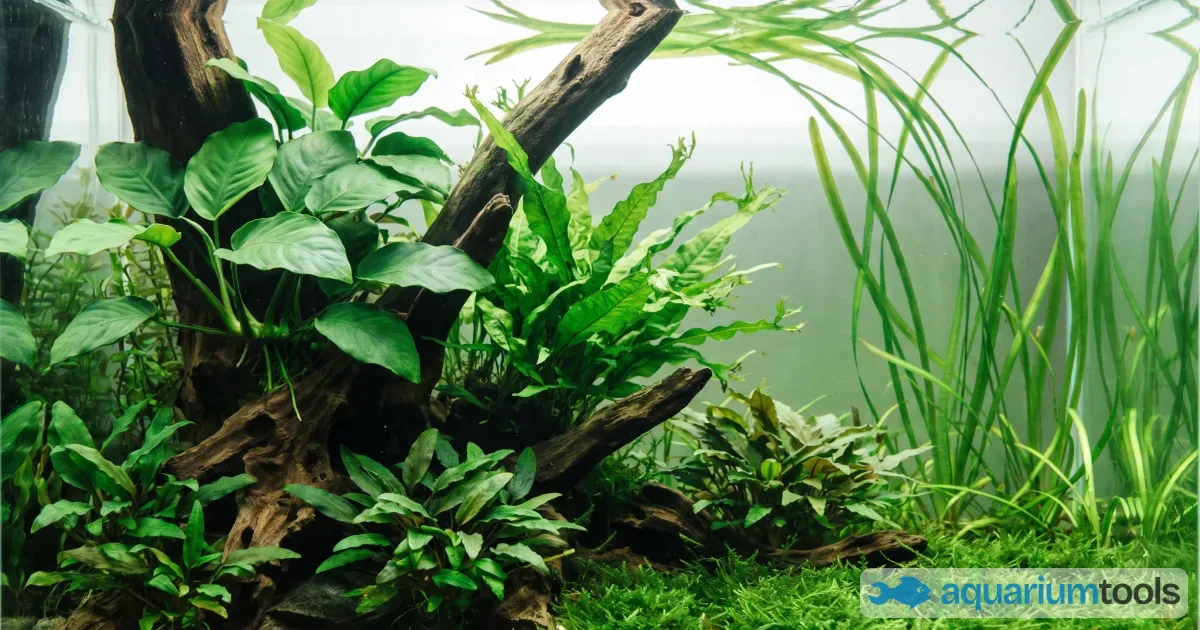
If you want to try live plants without complications, these five species are hardy, tolerant and require neither CO2 systems nor powerful lighting.
1. Anubias (Anubias barteri)
- Light: low to medium
- Position: foreground/midground
- Notes: the rhizome should be attached to rocks or wood and not buried, otherwise it rots. Slow growth, with leathery leaves rarely eaten by fish.
2. Java fern (Microsorum pteropus)
- Light: low to medium
- Position: midground
- Notes: like Anubias, it anchors to hard supports without burying the rhizome. Very hardy and also suited to slightly moving water.
3. Vallisneria (Vallisneria spiralis)
- Light: medium
- Position: background, ideal as a backdrop
- Notes: ribbon-like leaves that create a natural green wall. It propagates on its own via runners and should be planted in the substrate leaving the crown exposed.
4. Cryptocoryne (Cryptocoryne wendtii)
- Light: low to medium
- Position: foreground/midground
- Notes: very adaptable. After transplanting it may lose its leaves (the "crypt melt" phenomenon), but it recovers without problems as long as the rhizome remains in the substrate.
5. Java moss (Taxiphyllum barbieri)
- Light: low to medium
- Position: on wood, rocks and decorations
- Notes: a versatile and indestructible moss, an excellent refuge for fry and small invertebrates. Just tie it or rest it on a support.
For all these species, a suitable substrate, regular water changes and light liquid fertilisation are enough to achieve excellent results even without advanced equipment.
Comparison table
| Aspect | Real plants | Fake plants |
|---|---|---|
| Maintenance | Pruning, fertilisation, growth control | Minimal, only periodic cleaning |
| Light requirements | Needed (varies by species) | None |
| CO2 / nutrients | May be needed, depends on the species | Not required |
| Oxygenation | Yes, through photosynthesis | No |
| Nitrate absorption | Yes | No |
| Algae control | Yes, through competition | No (they can host algae) |
| Natural habitat | Excellent | Only physical shelter |
| Aesthetics over time | Changes with growth | Stable and constant |
| Initial cost | Variable, often low | Variable |
| Suitable with "destructive" fish | Not always | Yes |
Conclusion
Real plants are the best choice if you want an aquarium closer to a natural ecosystem, with concrete benefits for water quality and fish well-being: they require a little more attention, but the species listed above make entering the world of live plants truly accessible. Fake plants remain a valid solution for those seeking maximum convenience, for tanks with fish that damage vegetation or for areas that are difficult to light. Finally, there is nothing to stop you from combining the two options: hardy real plants as a biological base and a few artificial elements to complete the setup where needed.
All material on this site is protected by copyright. Partial or total copying and republishing without authorization is not allowed.
Comments
Join the conversation
Create a free account to leave a comment. It only takes a minute and you'll come right back here.
No comments yet. Be the first to share your experience.