Low-Tech Aquarium: A Guide to the Walstad Method Without CO2
The appeal of simplicity
In the popular imagination, a lush planted aquarium requires CO2 cylinders, powerful lighting and an almost laboratory-like fertilisation routine. Yet there is a different approach, inspired by natural processes and reducing technology to a minimum: the Low-Tech aquarium, of which the Walstad method is the best-known example. The underlying idea is simple: create a small, balanced ecosystem in which plants, bacteria and fish work together, letting nature do most of the work.
Why is it winning over so many enthusiasts? First of all for the cost savings: no CO2 system, no professional lighting, very few liquid fertilisers. Secondly for the reduced maintenance: fewer weekly interventions, rare water changes and a stability that grows over time. It is a slower, more sustainable way of keeping aquariums and, for many, deeply relaxing.
The foundation of the ecosystem: the substrate
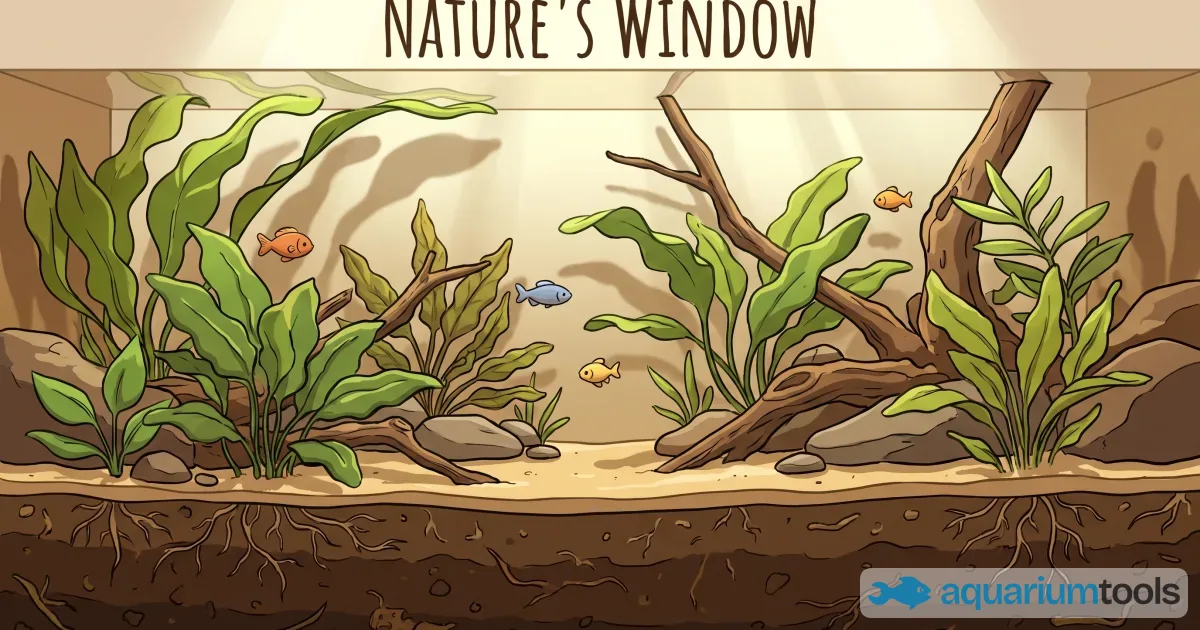
The heart of a Low-Tech aquarium is the substrate. Here the most distinctive choice of the Walstad method is the use of an underlayer of organic garden soil, unfertilised and free of chemical additives or perlite. This layer, often about 2.5-3 cm thick, is rich in nutrients and organic matter: it feeds the plants' roots for months or years without the need to fertilise the water.
On top of the soil goes a layer of fine gravel or sand (about 3-4 cm) that acts as a "cap": it holds the soil in place, prevents it from clouding the water and slows the release of nutrients. Alternatively, those who prefer a simpler start can use inert substrates (neutral sand or gravel), relying on fish waste and a few root fertiliser tablets. This is a slower solution to get going, but more predictable and less prone to early imbalances.
Whatever the choice, one principle remains valid: dense planting from day one. Filling the aquarium with plants right away means having organisms that immediately consume nutrients and ammonia, taking space and resources away from algae. A half-empty tank at the outset is the most common recipe for problems.
Selecting flora and fauna
The secret to a Low-Tech setup that works lies in choosing robust, undemanding plants, capable of thriving with moderate light and without added CO2. Here are the ideal protagonists:
- Anubias: very slow-growing but almost indestructible, they attach to rocks and wood (never bury the rhizome).
- Microsorum pteropus (Java fern): grows anchored to decor, tolerates a very wide range of conditions.
- Cryptocoryne: perfect for a rich substrate, they develop strong roots and interesting colouration.
- Vallisneria: fast upward growth, excellent for consuming nutrients and oxygenating.
- Mosses (such as Vesicularia): useful as a refuge for fry and microfauna.
- Floating plants (Limnobium, Salvinia, duckweed): essential because they absorb large amounts of nutrients directly from the air and water, provide shade and limit algae.
Floating plants deserve special attention: they are among the best allies against imbalances, but they need to be thinned regularly so they do not shade the tank too much.
For the fauna, one golden rule applies: a modest biological load. A Low-Tech setup is not designed for large populations. It is better to have a few small fish, introduced gradually and only after the plants have started to grow. Excellent candidates are small characins, rasboras, Boraras, guppies in small groups, together with shrimp and snails that help manage algae and detritus. A light population means less waste, less stress on the system and greater stability.
Management and maintenance
Here the great advantage of Low-Tech emerges: the routine is minimal. Since the plants actively consume the nutrients and waste produced by the fish, water changes are less frequent than in a traditional aquarium. Many people running the Walstad method carry out limited changes, focusing instead on topping up evaporated water. In the first few months, when the substrate releases many nutrients, it may be prudent to do a few extra partial changes to prevent excesses; over time the system stabilises and interventions decrease.
The most delicate point is managing the light. In the absence of added CO2, light that is too intense or left on too long creates an imbalance: the plants cannot use the excess energy and the algae take advantage. The winning strategy is:
- Use moderate-intensity LED lighting, suited to undemanding plants.
- Limit the photoperiod to about 6-8 hours a day, without overdoing it.
- Consider a midday break (the so-called "siesta"), which many find useful for keeping algae in check.
- Avoid direct sunlight, which is difficult to control.
Beyond that, maintenance mainly consists of pruning fast-growing plants, thinning the floating plants, removing decaying leaves and cleaning the glass. A light filter or simple water movement is often sufficient: in a well-established Low-Tech setup, biological filtration is handled mostly by the substrate and the roots.
Pros and cons: an honest assessment
The Low-Tech method is not a magic formula, but a smart compromise. Here are the main advantages and limitations to consider.
| Pros | Cons |
|---|---|
| Very low costs (no CO2, no expensive lights or fertilisers) | More delicate and unpredictable start-up phase |
| Minimal weekly maintenance | Requires patience: stability comes with time |
| Great long-term stability | Slower plant growth |
| Natural and sustainable approach | More limited choice of plants and fish |
| Low energy consumption | Less control over parameters compared to high-tech |
The real quality required of anyone choosing this system is patience. In the first few weeks algae, cloudiness or small fluctuations may appear: these are normal settling phases. Those who resist the temptation to intervene constantly are rewarded with a surprisingly balanced ecosystem that, after a few months, almost "runs itself".
Conclusion
The Low-Tech aquarium proves that complex systems are not needed to achieve a living, green and fascinating tank. With a good substrate, dense planting from day one, robust species, a light population and measured lighting, it is possible to build a small self-sufficient world. It is an invitation to slow down, observe and work with nature instead of forcing it: a more sustainable, economical and, for many, deeply satisfying way of keeping aquariums.
All material on this site is protected by copyright. Partial or total copying and republishing without authorization is not allowed.
Comments
Join the conversation
Create a free account to leave a comment. It only takes a minute and you'll come right back here.
No comments yet. Be the first to share your experience.