Amazon biotope: recreating the Rio Negro in your aquarium
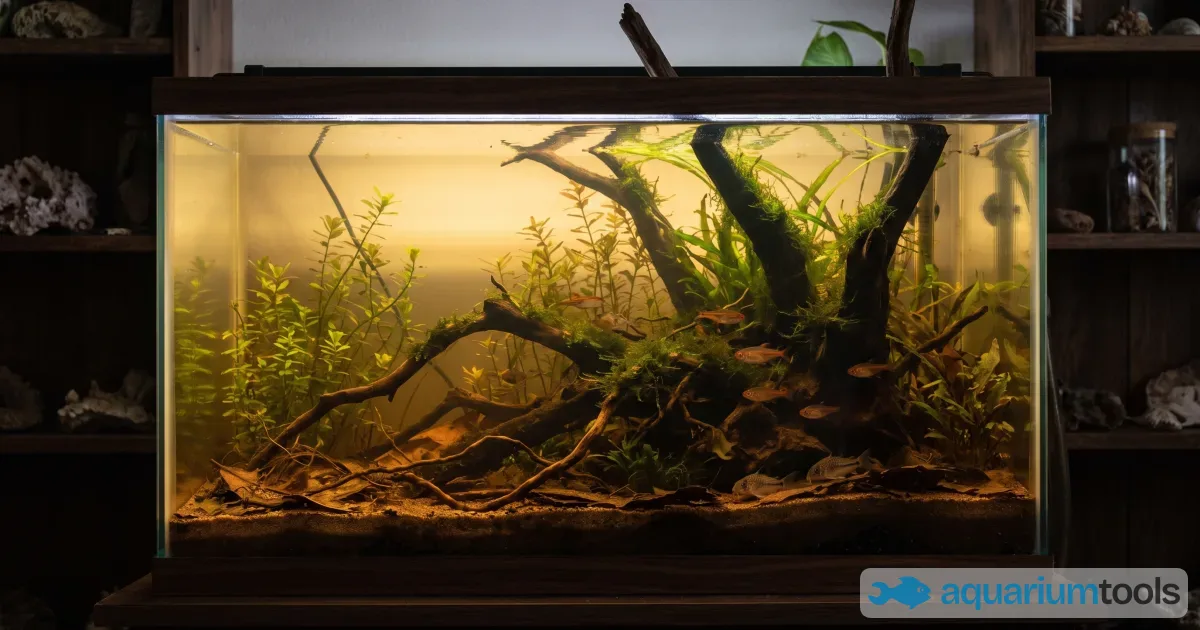
The Rio Negro is the largest black-water tributary of the Amazon basin and one of the most fascinating biotopes to reproduce in an aquarium. Its tea-coloured, acidic and salt-poor waters are home to some of the species most loved by aquarists all over the world. Recreating this environment is not just about putting fish and driftwood together: it means rebuilding a coherent ecosystem, where every element tells the same story. In this guide we'll see how to do it step by step, with a technical yet accessible approach.
The characteristics of Rio Negro water
The unmistakable signature of the Rio Negro is its water: transparent yet tinted an amber, almost coppery colour, due to the tannins and humic substances released by the decomposition of leaves and wood in the flooded forest. This aesthetic detail has precise chemical consequences that you need to know before you start.
- Acidic pH: in the natural biotope the values often drop between 4.5 and 6.0. In the aquarium a realistic and manageable range is between 5.5 and 6.5.
- Very soft water: the hardness is extremely low. Aim for a very low GH and KH (ideally KH close to 0-2 and GH below 4 °dGH).
- Low mineralisation: the conductivity is extremely low, a sign of water almost devoid of electrolytes.
- Temperature: warm and stable, between 26 and 30 °C depending on the species kept.
Be careful: with a low KH the buffering capacity is almost non-existent, so the pH can fluctuate rapidly. This is why the stability of the parameters and regular water changes are more important than chasing the lowest possible value.
How to get dark water with tannins
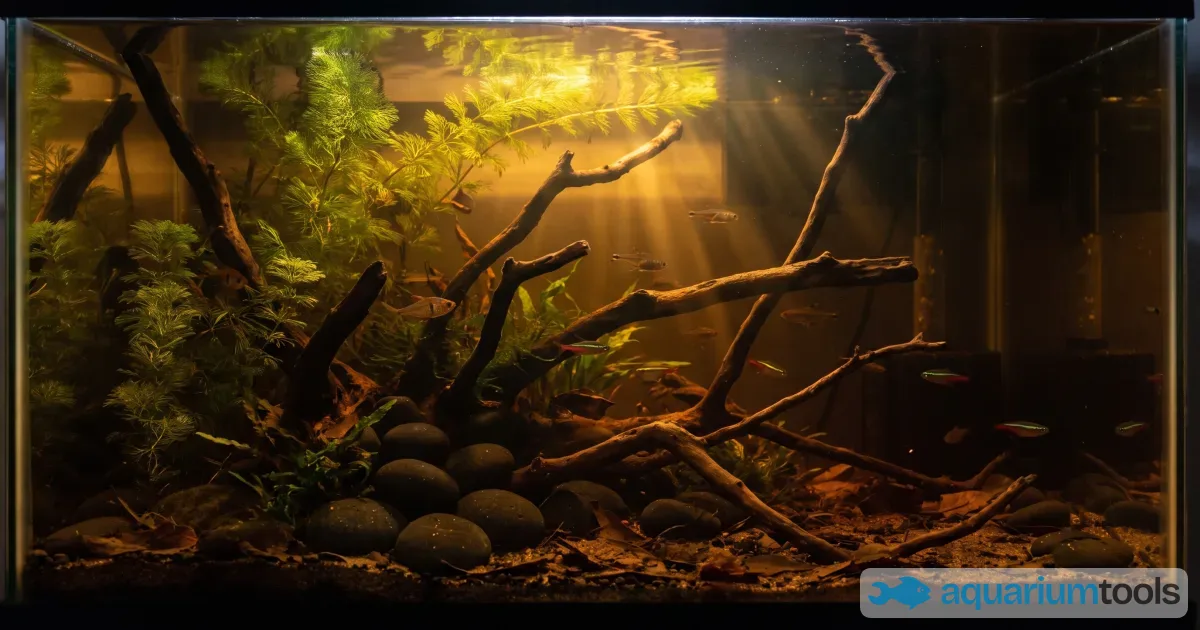
The amber colour is the heart of the biotope and it's obtained by releasing tannin-rich plant materials into the water. Here are the most effective and natural sources:
- Catappa leaves (Terminalia catappa): the classic. They release tannins, colour the water and have a mildly antibacterial effect. They're added directly to the tank and left to decompose.
- Alder, mopani or mangrove wood: as well as decorating, they release tannins for weeks or months.
- Alder cones and pine cones: small but very active in releasing humic substances.
- Liquid tannin/humic extracts: handy for acting quickly or maintaining the colour between one water change and the next.
A recommended method is to prepare the base water with osmosis water, which starts out salt-free and lets you precisely control GH and KH thanks to remineralising salts specific for soft water. On this base you then introduce the tannin sources. If you want to speed up the colouring effect without waiting, you can make a decoction of catappa leaves (leaves boiled in water) and dose it into the tank.
Remember: tannins slightly lower the pH and reduce the available oxygen. In a black-water biotope the current should be gentle, but good surface oxygenation remains essential.
Substrate and d\u00e9cor
The Rio Negro bottom is made up of light sand and plant debris, but in the aquarium a darker look is often preferred to make the fish's colours stand out. The ideal choice is a fine, dark-coloured sand, or at least a neutral one that doesn't alter the water parameters. Avoid calcareous substrates, which would raise the hardness and pH, undoing all your work.
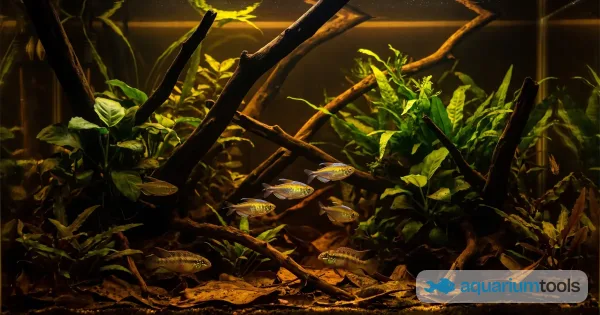
For the d\u00e9cor, think of a flooded forest: branches and roots emerging from the bottom, shaded areas and hiding spots. The typical elements are:
- Alder and mopani wood: they create the vertical structure and the tangle of branches typical of submerged banks.
- Roots and thin branches: for a natural, disorderly look, just like a real riverbank.
- Leaf litter on the bottom: catappa, dried oak or beech leaves. As well as releasing tannins, they recreate the bed of decomposing leaves that characterises the ecosystem and offers microhabitats.
Before adding them, remember that new pieces of wood tend to float: soak them or fix them in place until they become waterlogged.
Plants: present or absent?
This is a point where authenticity and aesthetics can diverge. In the real Rio Negro the submerged vegetation is scarce or absent: the acidic, soft and nutrient-poor water, combined with the poor light penetration caused by the amber colour, doesn't favour aquatic plants. A 100% faithful biotope is therefore essentially plant-free, dominated by wood and leaves.
If, however, you want a touch of green while staying plausible, some species tolerate these conditions:
- Echinodorus (the quintessential Amazonian plants, present in the basin even if not typical of the most extreme black waters).
- Mosses and epiphytic plants such as Microsorum, which anchor to the wood and don't need a nutrient substrate.
- Floating plants such as Salvinia or Ceratopteris, which filter the light and recreate the shade of the forest.
The most coherent choice, though, remains a "hardscape" layout made of wood, roots and leaves: it's precisely its restraint that makes the black-water biotope so evocative.
The fish of the Rio Negro
The black-water fauna is extremely rich and allows for spectacular combinations. Always choose species that are compatible in terms of parameters and temperament, and consider the size of the tank before stocking it.
Schooling fish
- Cardinal tetras (Paracheirodon axelrodi): the icon of the Rio Negro. In a large school, their red and blue stand out against the amber water and the dark bottom like no other fish.
- Neon tetras and small characins: excellent for adding movement in the central area of the tank.
Bottom-dwelling fish
- Corydoras: peaceful and always active on the substrate, perfect in a group. They prefer a soft, sandy bottom.
- Small loricariids: to bring the wood to life.
Dwarf cichlids and prized species
- Apistogramma: South American dwarf cichlids ideal for acidic and soft water. They occupy the lower zone and display fascinating territorial behaviours during breeding.
- Discus (Symphysodon): the king of Amazonian waters. It requires warm, soft, acidic and very clean water, as well as a large, tall tank. It's a demanding choice, suited to experienced aquarists.
A classic and harmonious cohabitation includes a school of cardinal tetras, a small group of corydoras and a pair of apistogramma: balanced proportions, compatible needs and an authentic look. The discus can become the centrepiece species of a dedicated setup, with greater volumes and care.
Management and maintenance
A black-water biotope is relatively stable once it's up and running, but it requires specific attention:
- Regular water changes with remineralised osmosis water, to keep GH, KH and pH constant.
- Periodic tannin top-ups: the amber colour tends to fade over time, so used leaves and cones need to be replaced.
- Parameter monitoring: check pH and conductivity consistently, especially because of the low buffering capacity.
- Gentle filtration: prefer a moderate current and good bacterial colonisation, avoiding materials that alkalinise the water.
In summary
Recreating the Rio Negro means embracing a minimal aesthetic and a precise chemical balance: soft, acidic water, tinted amber by tannins, a dark bottom dotted with wood and leaves, and fish chosen coherently. It's a biotope that rewards patience and attention to detail, giving back in return one of the most poetic spectacles that fishkeeping can offer: a fragment of flooded Amazonian forest, right in your living room.
Keep reading
Lake Tanganyika biotope: sand, shells and unusual cichlids
A guide to the Lake Tanganyika biotope: alkaline, hard water parameters, typical rock and shell setups, and the fascinating behaviour of Shell Dweller cichlids.
European Stream Biotope: Setting Up an Aquarium With Native Fish
An uncommon yet fascinating approach: recreating a European stream in an aquarium with fresh, well-oxygenated water and often overlooked native species. Here's how to set it up correctly and in compliance with regulations.
Congo River Biotope: An Underrated African Ecosystem
Discover the Congo basin biotope: acidic, tinted waters, submerged wood, dwarf cichlids, Congo tetras and catfish. A practical guide to recreating it in your aquarium.
All material on this site is protected by copyright. Partial or total copying and republishing without authorization is not allowed.
Comments
Join the conversation
Create a free account to leave a comment. It only takes a minute and you'll come right back here.
No comments yet. Be the first to share your experience.