Lake Tanganyika biotope: sand, shells and unusual cichlids
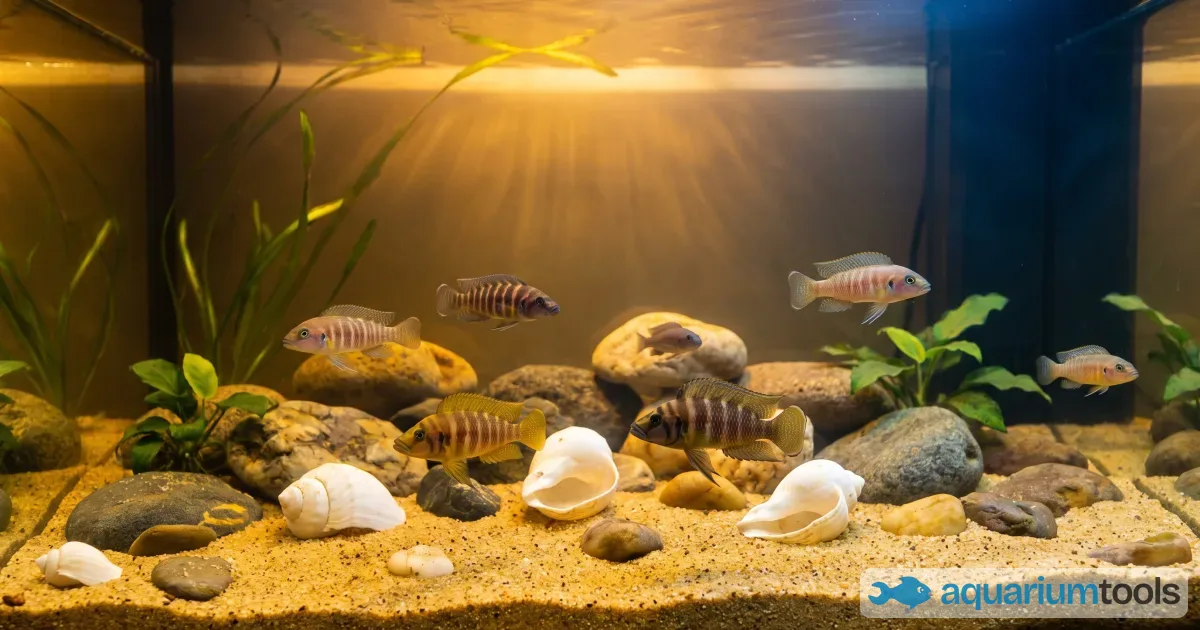
Lake Tanganyika is one of the oldest and most fascinating freshwater basins on the planet. Located in East Africa, along the Rift Valley, it is home to an extraordinary variety of endemic cichlids that have evolved into extremely specialised ecological niches. Recreating a Tanganyikan biotope in an aquarium means working with very particular water parameters and with setups that reflect clearly distinct natural environments: on one hand the rocky zones, on the other the sandy bottoms dotted with empty shells. In this article we look at how to set up the environment and, above all, how to interpret the behaviour of its most curious inhabitants, the Shell Dweller cichlids.
Water parameters: alkaline, hard and stable
The defining characteristic of Tanganyika is its heavily mineralised water. Unlike many tropical biotopes where you aim for soft, slightly acidic water, here you need to steer towards decidedly alkaline and hard values. It is these conditions that allow the cichlids of this lake to thrive and to display their natural colours and behaviours.
The typical reference values are as follows:
| Parameter | Recommended value |
|---|---|
| pH | 8.5 - 9.0 |
| Carbonate hardness (KH) | 12 - 18 dKH |
| Total hardness (GH) | 10 - 20 dGH |
| Temperature | 24 - 27 °C |
| Conductivity | high, mineral-rich environment |
The key word is stability. Lake Tanganyika is an enormous environment and its conditions vary very little over time. In an aquarium this translates into the need for strong buffering power, which is achieved thanks to a calcareous substrate and decor. Calcium carbonate-based sands and rocks help maintain high pH and KH naturally, avoiding dangerous crashes in the values. Good oxygenation and efficient filtration are also essential, because these cichlids poorly tolerate build-ups of nitrogen compounds.
Two typical setups for a single lake
Tanganyika is not a uniform environment. In the aquarium people tend to reproduce mainly two habitats, corresponding to two groups of cichlids with different requirements.
1. The rocky setup for rock-dwelling species
The lake's rocky zones are populated by cichlids that live in close contact with the stone walls, where they find shelter, territories to defend and surfaces rich in microorganisms to graze on. To reproduce this environment you build structures with stacked rocks, creating crevices, caves and passages.
Some practical tips:
- Use inert or stable calcareous rocks, well interlocked to prevent collapses.
- Rest the stones directly on the base glass, before adding the sand, to ensure stability.
- Create numerous hiding places, since many rock-dwelling species are territorial.
- Provide adequate volumes, because several rock species reach considerable sizes.
2. The sand and shell setup for Shell Dwellers
The second scenario is the most fascinating for those who love unusual behaviours: stretches of fine sand on which empty shells lie. In nature these shells belong to snails of the genus Neothauma, but in the aquarium edible snail shells are commonly used, well cleaned and free of residue. This is the realm of the Shell Dwellers, the cichlids that live, breed and defend their territory in and around a shell.
For this setup you need:
- A layer of fine sand a few centimetres deep, allowing the animals to dig.
- Numerous shells, in a quantity greater than the number of fish, so that each one can choose and change shelter.
- Few or no bulky rocks, to leave open space on the bottom.
- A layout that highlights the sandy areas, the heart of these species' life.
Shell Dweller cichlids: small, intelligent, territorial
Shell Dwellers are among the most beloved cichlids for enthusiasts with medium-sized aquariums, and rightly so. Many species of the genus Neolamprologus, such as Neolamprologus multifasciatus and Neolamprologus similis, stay very small in size, often just a few centimetres. This makes them suitable even for tanks that are not enormous, provided they are correctly set up.
Their name comes from their lifestyle: the empty shell is the centre of their existence. There they take refuge at the slightest danger, there they lay their eggs, there the fry grow. Observing them means witnessing a continuous work of engineering and territorial defence.
Behaviours to observe
What makes these fish so interesting is the richness of their behavioural repertoire, surprising for such small animals:
- Sand digging: Shell Dwellers continuously move the sand with their mouths, positioning the shells at their preferred angle and sometimes partially burying them or creating small defensive craters.
- Territoriality: each individual or pair defends a range of action around its own shell, driving off intruders with displays and chases, usually without serious harm in adequate spaces.
- Parental care: females lay inside the shell and actively guard their offspring. Several species show complex social structures, with family groups sharing a common area.
- Communication: through postures, fin movements and small displays, these cichlids continuously communicate states of alertness, courtship and dominance.
Many Shell Dweller species tend to form true colonies. In a large, well-structured tank with abundant shells, you can observe the emergence of an articulated social structure, with dominant and subordinate individuals sharing the same sandy bed. It is a spectacle that recalls, in miniature, the dynamics of the lake's natural bottoms.
Specific requirements in the aquarium
To allow Shell Dwellers to express all their natural behaviour, some conditions are non-negotiable:
- Deep sandy bottom: the sand is not decoration, but an element functional to digging behaviour and the stability of the shells.
- Excess shells: providing more shells than fish reduces conflicts and allows the choice of the ideal shelter.
- Alkaline, stable water: correct and constant values are essential for health and reproduction.
- Compatible tankmates: in the sandy zone it is better to avoid species that are too large or intrusive and would take up the space on the bottom. Some medium-sized species that swim in the upper part of the tank can coexist, if the volume allows.
- Appropriate feeding: small foods of animal origin and specific cichlid feeds meet their needs, without excesses that would compromise water quality.
A biotope that rewards observation
Recreating Tanganyika does not necessarily require giant tanks: the sand and shell setup with Shell Dwellers is precisely ideal for medium-sized aquariums, where just a few centimetres of fish deliver a density of behaviours rarely matched. The key to success lies in consistency: alkaline, hard water kept stable, a substrate designed for digging, and an adequate number of shells that become the stage for the life of these little cichlids.
Those who choose this biotope soon discover that its value is not only aesthetic. The richness lies in observing intelligent animals that build, defend and raise their offspring in a small space, reproducing at home a faithful fragment of one of the most extraordinary lakes in the world.
Keep reading
European Stream Biotope: Setting Up an Aquarium With Native Fish
An uncommon yet fascinating approach: recreating a European stream in an aquarium with fresh, well-oxygenated water and often overlooked native species. Here's how to set it up correctly and in compliance with regulations.
Congo River Biotope: An Underrated African Ecosystem
Discover the Congo basin biotope: acidic, tinted waters, submerged wood, dwarf cichlids, Congo tetras and catfish. A practical guide to recreating it in your aquarium.
Lake Malawi Biotope: Rocks, Cichlids and Hard Water
A practical guide to recreating the Lake Malawi environment in your aquarium: alkaline, hard water, a rockscape with caves, pale sand and a selection of Mbuna and Peacock cichlids, with the rules for managing aggression and stocking.
All material on this site is protected by copyright. Partial or total copying and republishing without authorization is not allowed.
Comments
Join the conversation
Create a free account to leave a comment. It only takes a minute and you'll come right back here.
No comments yet. Be the first to share your experience.