Lake Malawi Biotope: Rocks, Cichlids and Hard Water
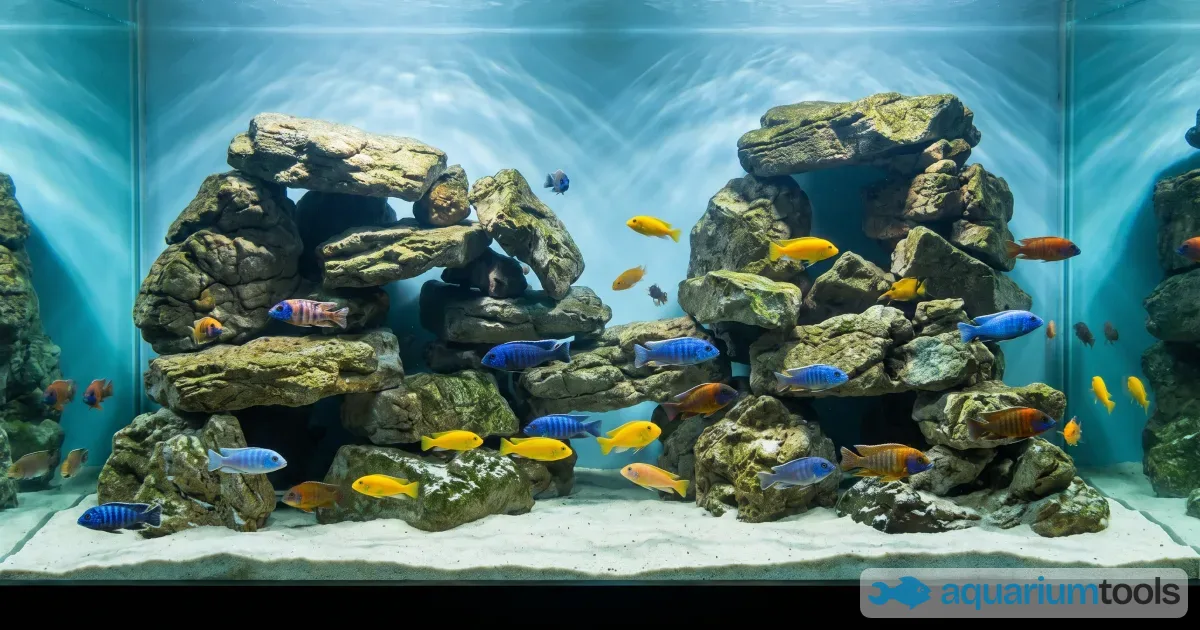
Lake Malawi, nestled in the Rift Valley of East Africa, is one of the most fascinating basins for the aquarium hobby. Its clear, alkaline, mineral-rich waters are home to hundreds of species of endemic cichlids with spectacular colours. Recreating this biotope means combining water with very precise characteristics, a carefully planned rocky layout and attentive management of the fish's social dynamics. In this guide we will look step by step at how to do it.
The characteristics of Lake Malawi water
The first distinctive element of this biotope is the water. Lake Malawi is an extremely stable environment, with parameters that differ greatly from those of a classic tropical community aquarium. Reproducing them correctly is not an aesthetic detail: it is the foundation for the health and colours of the cichlids.
- pH: markedly alkaline, generally between 7.8 and 8.6.
- Carbonate hardness (KH): high, roughly between 8 and 15 °dKH, essential for stabilising the pH.
- Total hardness (GH): medium to high, often between 10 and 20 °dGH.
- Temperature: between 24 and 27 °C, with good stability.
- Conductivity: relatively high, consistent with the mineral richness.
To achieve these values starting from soft tap water or RO water, special mineral salts for Malawi cichlids are used, adding carbonates, calcium and magnesium in the right proportions. Alternatively, an aragonite substrate or the addition of limestone rocks help buffer the water towards alkaline values. The important thing is to reach a stable balance: it is precisely sudden fluctuations, more than the values themselves, that stress the fish.
Practical tip: measure the parameters before every water change and top up the salts so that the new water has the same values as the water in the tank. This way you avoid swings that weaken the cichlids.
The layout: the rockscape and its caves
The aesthetic of the Malawi biotope is dominated by rocks. In the lake's littoral zone, cichlids live among rocky masses that offer endless nooks, caves and shelters. Recreating a believable rockscape is not just for show: the rocky structure is the main tool for managing the fish's territoriality.
How to build the structure
The goal is to create many hiding places, passages and interrupted lines of sight. An environment with many caves allows fish to carve out distinct territories and subordinate individuals to escape the sight of dominant ones.
- Use limestone-type or otherwise inert, non-sharp rocks, such as lava, limestone or ohko stones.
- Stack the rocks stably, resting them on the bottom glass or on a support plate, not on the substrate, to prevent collapses caused by digging fish.
- Create caves, crevices and overhangs at different heights, so as to multiply the available territories.
- Leave open sandy spaces in front of the structure, where the fish can swim and display.
Structural safety is essential: Malawi cichlids move gravel and dig vigorously, and a poorly built rockscape can give way and damage the tank. Always check stability before introducing the fish.
The substrate: pale sand
The typical bottom is pale sand, which reflects light and highlights the cichlids' colours. Fine or medium grain sand is ideal: many species love to dig it, move it and sift through it in search of food. Sand of a calcareous nature (aragonite or finely ground coral sand) has the advantage of helping to keep hardness high and to buffer the pH, naturally supporting the biotope's chemical profile.
Avoid acidifying substrates or allophane plant soils, which would work against the desired alkalinity. A layer of 3-5 cm is enough for aesthetics and to allow the fish to display their natural digging behaviour.
Vegetation, in this biotope, is scarce or absent: the lake's rocky areas are poor in plants and Mbuna cichlids tend to uproot or eat most species anyway. If you want a touch of green, you can opt for robust, leathery plants such as Anubias or Vallisneria, anchoring them to the rocks, but this remains a matter of taste rather than biotope fidelity.
The cichlids: Mbuna and Peacock
Lake Malawi is home to two large groups that are very popular in the aquarium hobby, with different needs and behaviours.
Mbuna
Mbuna are the cichlids of the rocks: lively, extremely colourful and strongly territorial. They spend much of their time grazing on aufwuchs, the film of algae and microorganisms that covers the stones, so they have a mainly plant-based diet. They are often the most aggressive in the lake. Among the most widespread genera:
- Pseudotropheus and relatives, with bright colours.
- Labidochromis, such as the famous yellow Labidochromis caeruleus, among the most peaceful of the group.
- Metriaclima (often referred to as Maylandia), with blue liveries and barring.
- Melanochromis, very beautiful but tending to be combative.
Peacock (Aulonocara)
The Peacocks of the genus Aulonocara more often live in the transition zones between rock and sand. They are generally less aggressive than Mbuna, with males displaying extraordinary metallic colours. They have a more carnivorous diet, hunting small invertebrates in the substrate. Be careful, however, not to mix herbivorous Mbuna and Peacocks in the same tank without proper knowledge: the different dietary needs and temperaments can create problems, and Aulonocara risk being overwhelmed by the more assertive Mbuna.
Managing aggression and stocking
Territoriality is the real challenge of this biotope. In nature the fish have unlimited space to flee; in a tank they do not. The good news is that, with a few tried and tested strategies, it is possible to keep tensions under control.
- Controlled overstocking: keeping a relatively high number of specimens dilutes aggression, because no individual manages to monopolise too large a territory. This, however, requires powerful filtration and frequent water changes.
- Male/female ratio: keep one male with several females (roughly three to five per male, depending on the species) to spread out the attention of the dominant male.
- Avoid species that are too similar: males of species with similar colours and shapes mistake each other for rivals and clash. It is better to choose clearly distinct liveries.
- A long, spacious tank: starting from at least 200-250 litres, with a wide base, offers more territories and escape space.
- Many hiding places: a rockscape rich in caves is the best ally against bullying among fish.
Always observe the group: if an individual is constantly harassed, shows clamped fins or dull colours and stays hidden, it is a sign that the balance needs correcting, by reviewing the ratio between the sexes or the mix of species.
Filtration, maintenance and feeding
The high density of fish and the voracious appetite of the cichlids generate a significant organic load. You need filtration that is oversized relative to the volume, with plenty of biological media, and regular water changes (roughly 25-40% weekly) to keep nitrates down and hardness and pH stable.
On the feeding front, respect the needs of the groups: plant-based foods rich in spirulina for Mbuna, more protein-rich, granular foods for Peacocks. An excess of protein in herbivorous Mbuna can cause digestive problems known as "Malawi bloat", so it is better to use specific foods and measured rations.
In summary
Recreating the Lake Malawi biotope means building an environment that is coherent in every part: alkaline, hard water, pale sand, a rockscape rich in caves and a population of cichlids chosen with care. The key to success lies in anticipating the fish's social dynamics, offering space, shelters and a balanced stocking. With stable parameters and constant maintenance, this biotope rewards you with one of the most intense displays of colour that the aquarium hobby can offer.
Keep reading
Lake Tanganyika biotope: sand, shells and unusual cichlids
A guide to the Lake Tanganyika biotope: alkaline, hard water parameters, typical rock and shell setups, and the fascinating behaviour of Shell Dweller cichlids.
European Stream Biotope: Setting Up an Aquarium With Native Fish
An uncommon yet fascinating approach: recreating a European stream in an aquarium with fresh, well-oxygenated water and often overlooked native species. Here's how to set it up correctly and in compliance with regulations.
Congo River Biotope: An Underrated African Ecosystem
Discover the Congo basin biotope: acidic, tinted waters, submerged wood, dwarf cichlids, Congo tetras and catfish. A practical guide to recreating it in your aquarium.
All material on this site is protected by copyright. Partial or total copying and republishing without authorization is not allowed.
Comments
Join the conversation
Create a free account to leave a comment. It only takes a minute and you'll come right back here.
No comments yet. Be the first to share your experience.