Christel Kasselmann: the botanist who mapped aquarium plants
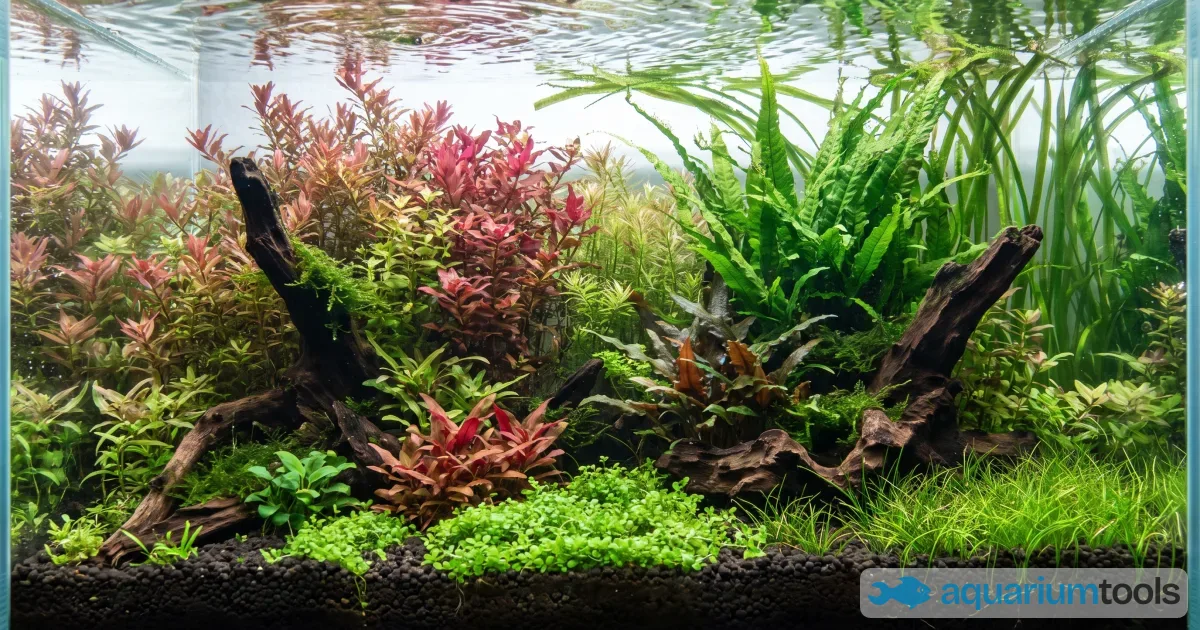
Anyone who grows plants in an aquarium will, sooner or later, come across her name. Christel Kasselmann is a German botanist known internationally for her study of aquatic plants and for a body of educational and scientific work that has accompanied generations of enthusiasts. In botanical citations she appears with the standard abbreviation Kasselm., the mark that her work has left traces not only in hobby aquarium-keeping, but also in the taxonomic literature of plants.
Her figure is interesting precisely because it brings together two worlds that too often remain separate: the rigour of academic botany and the concrete passion of someone who keeps an aquarium at home. For this reason, for anyone who wants to truly understand the plants they grow, her name represents a reliable point of reference.
The path: from botany to submerged plants
Kasselmann trained in the field of botany and very early directed her interest towards aquatic and marsh plants, a fascinating and complex group precisely because it lives at the boundary between two environments, water and air. Many of these species, in fact, completely change appearance depending on whether they grow submerged or emerged, a phenomenon that has always confused aquarists and that requires solid botanical expertise to be interpreted correctly.
It is precisely this ability to distinguish species on the basis of reliable botanical characters, and not just on their appearance in the tank, that makes her work so valuable. In a hobby where commercial names multiply and often contradict each other, a rigorous taxonomic approach helps to bring order.
Fieldwork: studying plants in their habitat
One of the aspects that sets Kasselmann apart is the enormous amount of work carried out directly in the field. Over the course of her activity she has undertaken numerous expeditions to the tropical regions of various continents to observe aquatic plants in their natural biotopes, not just in cultivation.
This kind of research is not a simple observation trip. On site, concrete ecological data are collected: analysis of water parameters, characteristics of the substrate, light conditions and the structure of the environment in which the plant grows spontaneously. This information is fundamental, because it explains why a species thrives in certain conditions and struggles in others.
For the aquarist, the value is immediate: knowing that a plant grows in soft, shaded waters, or in bright, well-oxygenated streams, makes it possible to recreate in the tank conditions closer to natural ones. Kasselmann's work has helped transform plant cultivation from empirical trial into a practice based on real data.
"Aquarium Plants": the reference work
Christel Kasselmann's best-known contribution is the volume published in German as Aquarienpflanzen and in English as Aquarium Plants, published by Eugen Ulmer Verlag. The book is considered by many enthusiasts and retailers to be a true reference work on aquarium plants, for the breadth of species covered and for the combination of botanical descriptions, cultivation notes and rich photographic documentation.
The strength of the text lies in its balance: on the one hand, precision in the classification and distinction of species, and on the other, practical guidance on how to grow them. For this reason it is often described, with a certain emphasis but not unfairly, as the "bible" of aquarium plants. It is the kind of volume that you consult for years, both to identify an unknown plant and to understand how to keep it healthy.
Knowing the correct name of a plant is not pedantry: it is the first step to knowing what it really needs in order to grow.
Recognised botany, not just popular science
Kasselmann's work is not limited to the hobby sphere. Her activity is also recognised on a scientific level: her name, with the abbreviation Kasselm., is registered in the International Plant Names Index (IPNI), the international repertory of plant names and their respective authors. Moreover, her botanical collections are linked to the Botanic Garden and Botanical Museum of Berlin, one of Europe's leading institutions for the conservation and study of plants.
This dual recognition is important to emphasise: it means that those who read her works are not consulting mere cultivation tips, but the fruit of serious, documented and verifiable botanical work.
The legacy for aquarium-keeping and aquascaping
Christel Kasselmann's impact on the aquarist community is deep and, in some ways, quiet. Much of the information we take for granted today when we choose or grow a plant derives, directly or indirectly, from a body of study and systematisation to which she contributed decisively.
In the era of aquascaping, where the aesthetics of the layout have taken on a central role, this wealth of knowledge remains more relevant than ever. An aquascape that is beautiful but made up of plants treated inadequately is destined to deteriorate; conversely, understanding the real needs of each species is the foundation for lasting compositions. The underlying message of Kasselmann's work is precisely this: behind every plant there is a natural environment to be understood and, as far as possible, respected.
For the passionate aquarist, engaging with her work means taking a step up in quality: no longer considering plants as mere decoration and beginning to treat them as living organisms, with precise ecological histories. This is, perhaps, her most precious legacy.
Sources
- International Plant Names Index (IPNI), author record "Kasselm.": https://www.ipni.org/
- Eugen Ulmer Verlag, publisher and book page for Aquarienpflanzen: https://www.ulmer.de/
- Botanischer Garten und Botanisches Museum Berlin (Botanic Garden and Botanical Museum of Berlin): https://www.bo.berlin/
- Encyclopaedic entry on Christel Kasselmann, German-language Wikipedia: https://de.wikipedia.org/wiki/Christel_Kasselmann
Keep reading
George Farmer: aquascaper and educator between past and present
A portrait of George Farmer, the British aquascaper known for his planted aquariums and his intense educational work spanning magazines, videos and workshops. A profile covering style, community and educational content.
William T. Innes: the pioneer of American aquarium keeping
The story of William T. Innes, a Philadelphia publisher and naturalist who, through his books and his magazine, helped turn tropical fish keeping into a widespread and organised hobby in the United States.
Takashi Amano: the father of modern aquascaping
The story of Takashi Amano, the Japanese photographer and aquarist who turned the aquarium into an art form, founding ADA and giving birth to the Nature Aquarium style.
All material on this site is protected by copyright. Partial or total copying and republishing without authorization is not allowed.
Comments
Join the conversation
Create a free account to leave a comment. It only takes a minute and you'll come right back here.
No comments yet. Be the first to share your experience.