How to Fight Invasive Algae in Your Aquarium
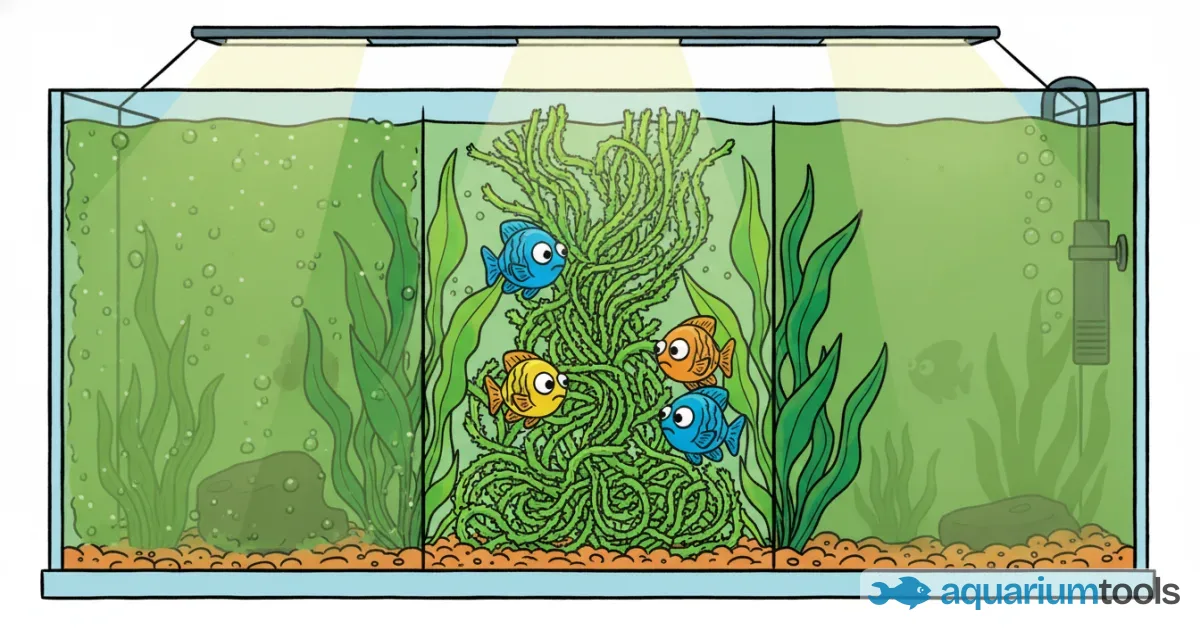
Algae are the number one frustration of every aquarist, beginner or expert. The good news is that they are almost never a "random" problem: they appear when something in the tank's balance is out of place. In this guide we'll learn to recognise the three most common types, understand why they develop, and tackle them with a practical approach, from the natural remedy to the more targeted one.
First rule: algae are a symptom
Algae don't come from nowhere. They thrive when they find the right combination of light, nutrients (nitrates and phosphates) and unstable CO2. Before rushing out to buy products, ask yourself: am I lighting for too long? Am I overfeeding the fish? Do I change the water regularly? Correcting the underlying cause is what really solves the problem; direct remedies only serve to clean up what is already present.
Green algae
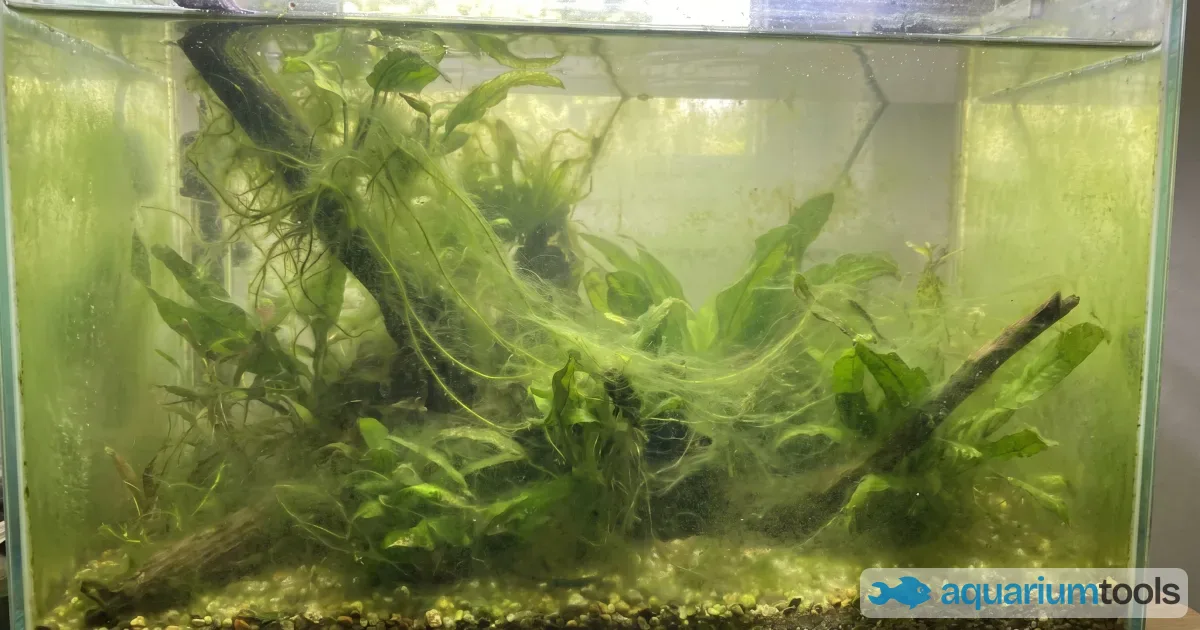
These are the most widespread and include different forms: a green film on the glass, filamentous strands that tangle among plants, or the dreaded "green water" (a bloom of suspended algae that makes the water cloudy and greenish).
How to recognise them
- Film on the glass: a green veil that forms within a few days, easy to remove with a sponge.
- Filamentous: long, thin green strands attached to plants, decorations and glass.
- Green water: widespread cloudiness, the tank looks "fogged" with green.
Main causes
An excess of light (intensity or too long a photoperiod, direct sunlight) combined with a surplus of nutrients. Green water often follows a spike in nitrates and phosphates, typical after a restart or overfeeding.
Natural solutions
- Reduce the photoperiod to 6–8 hours a day and move the tank away from windows.
- Increase the frequency of water changes (25–30% weekly) to lower nutrients.
- Introduce algae eaters: Otocinclus, Neritina snails and shrimp such as Amano keep films and filamentous algae in check.
- Add fast-growing plants (limnophila, vallisneria, floating plants) that compete with algae for nutrients.
Targeted remedies
For green water, where algae eaters can't reach, a UV-C filter is the most effective solution: it eliminates suspended algae within a few days. Alternatively, a total blackout of the tank (covered in the dark for 3–4 days) can interrupt the bloom, provided the plants can tolerate it.
Brown algae (diatoms)
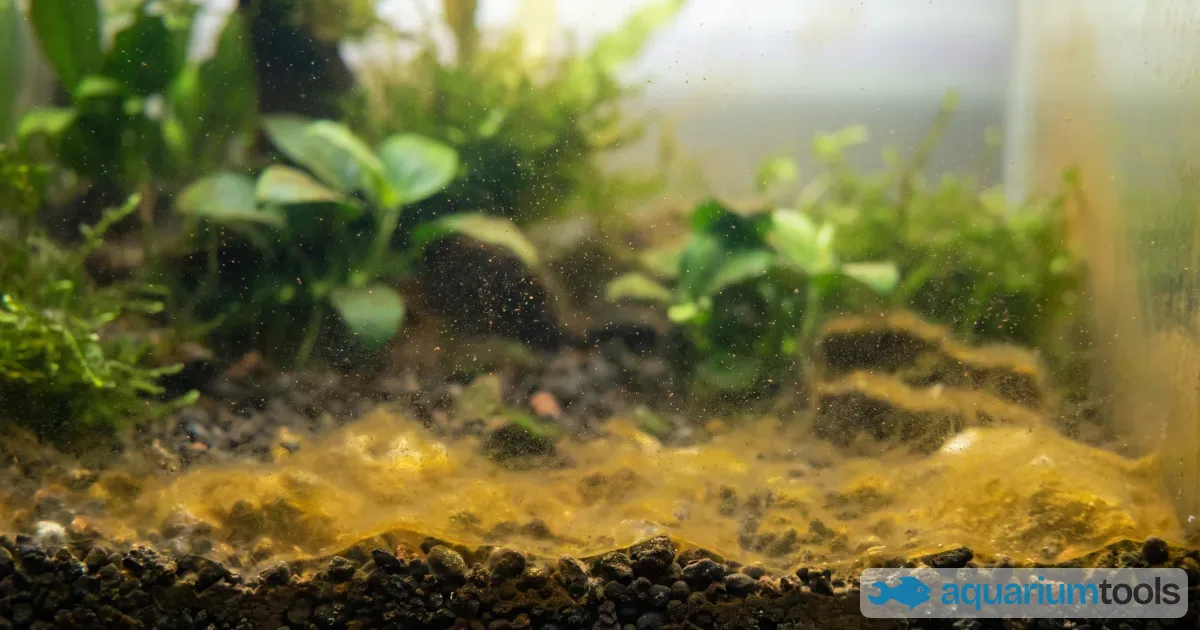
These are the typical algae of new tanks. They form a brown-brown dust that covers glass, decorations, gravel and leaves.
How to recognise them
A brown, dusty film, easy to remove with a finger or a sponge. It comes off in little clouds when you touch it. They appear mainly in the first weeks after setup.
Main causes
Diatoms thrive with high concentrations of silicates and in conditions of scarce or unstable lighting, typical of an aquarium that is not yet mature. They often disappear on their own once the silicates run out and the nitrogen cycle stabilises.
Natural solutions
- Patience: in a new tank they often disappear after 4–8 weeks, with biological maturation.
- Remove the film at every water change by cleaning the glass and decorations.
- Otocinclus and Neritina snails are enthusiastic devourers of diatoms.
Targeted remedies
If they persist, check the quality of your tap water (silicates often come from the tap): using RO water or specific resins for silicates helps. Stabilise the photoperiod with a timer to avoid irregular switching on and off.
Brush algae / BBA (Black Beard Algae)
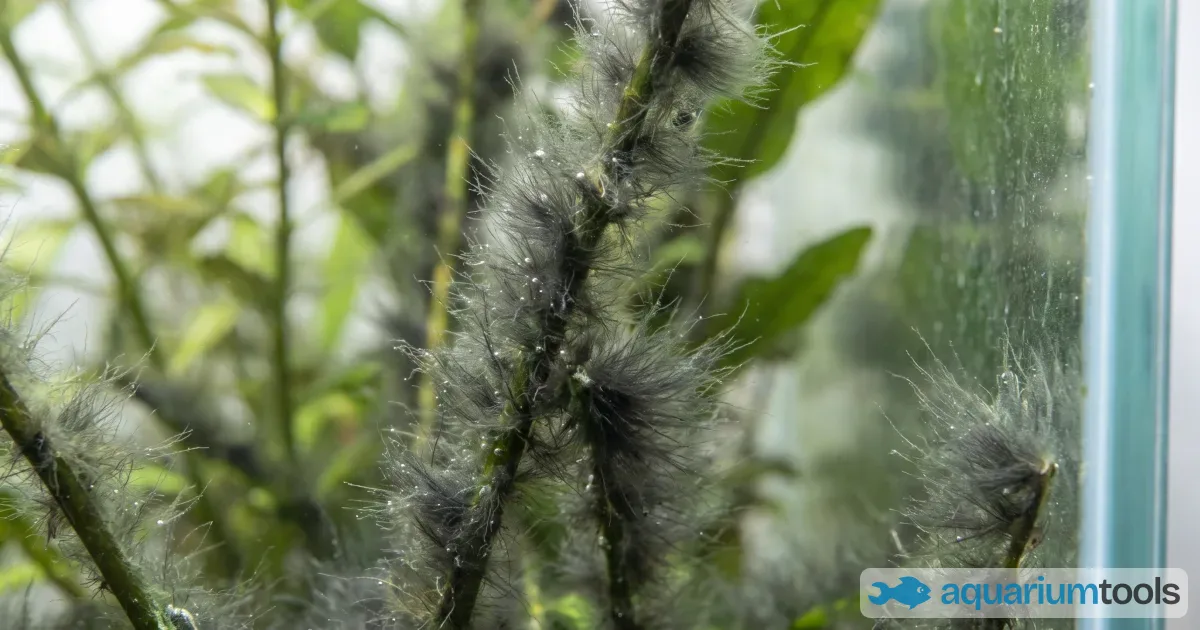
These are among the most stubborn. They form dark tufts, from grey-green to black, resembling fuzz or a beard, which adhere tenaciously to surfaces.
How to recognise them
Short, dense tufts that grow mainly on the edges of leaves, on rocks, on wood and near the filter outlet, where the current is strongest. They are difficult to detach by hand, a distinctive feature compared to other algae.
Main causes
The key factor is low or unstable CO2 combined with a high water flow rich in nutrients. An accumulation of organic debris and irregular maintenance encourage their appearance.
Natural solutions
- Stabilise the CO2 (in planted tanks) and improve flow distribution, avoiding zones of excessive current.
- Manually remove the affected parts: cut off heavily infested leaves and take out movable decorations to clean them outside the tank.
- Siamese Algae Eaters (Crossocheilus) are among the few fish that actively eat BBA.
Targeted remedies
The most effective method is localised treatment with hydrogen peroxide or liquid carbon-based products: it is applied directly to the tufts (with the tank partially emptied or with a syringe while the filter is off), the algae turn red/grey and die within days. Be careful with dosages and sensitive species. Heavily infested rocks and decorations can be immersed in a diluted bleach solution, then rinsed and neutralised with plenty of water before being reinserted.
Long-term prevention
Defeating algae once is of little use if they come back. The real victory lies in maintaining a stable balance. Here are the pillars:
- Manage the light: use a timer, keep a photoperiod of 6–8 hours and don't keep the lighting more intense than necessary. Replace old fluorescent tubes that alter the spectrum.
- Don't overfeed: give little food, what the fish consume in a couple of minutes. Excess food is the primary source of nutrients for algae.
- Regular water changes: 20–30% a week keeps nitrates and phosphates under control. Vacuum the substrate to remove debris.
- Plants as allies: a well-planted tank, especially with fast-growing species, deprives algae of nutrients. Plants that struggle, on the other hand, release nutrients that algae exploit.
- Filter maintenance: clean the sponges regularly (in tank water) to avoid build-up, but without overdoing it so as not to compromise the bacterial flora.
- Monitor the values: keep nitrates and phosphates under control with periodic tests. Balanced and stable values are the best defence.
- Introduce a "cleaning crew": Amano, Otocinclus, Neritina and Siamese Algae Eaters, sized to the tank, help prevent the first hints of infestation.
Remember: a mature, stable and not overcrowded aquarium naturally produces fewer algae. Consistency in maintenance beats any miracle product.
Tackle algae like a detective: identify the type, trace the cause, correct the imbalance and only then use the targeted remedy to clean up. With this approach your tank will stay clear and healthy over time.
All material on this site is protected by copyright. Partial or total copying and republishing without authorization is not allowed.
Comments
Join the conversation
Create a free account to leave a comment. It only takes a minute and you'll come right back here.
No comments yet. Be the first to share your experience.