The importance of the substrate: sand or gravel?
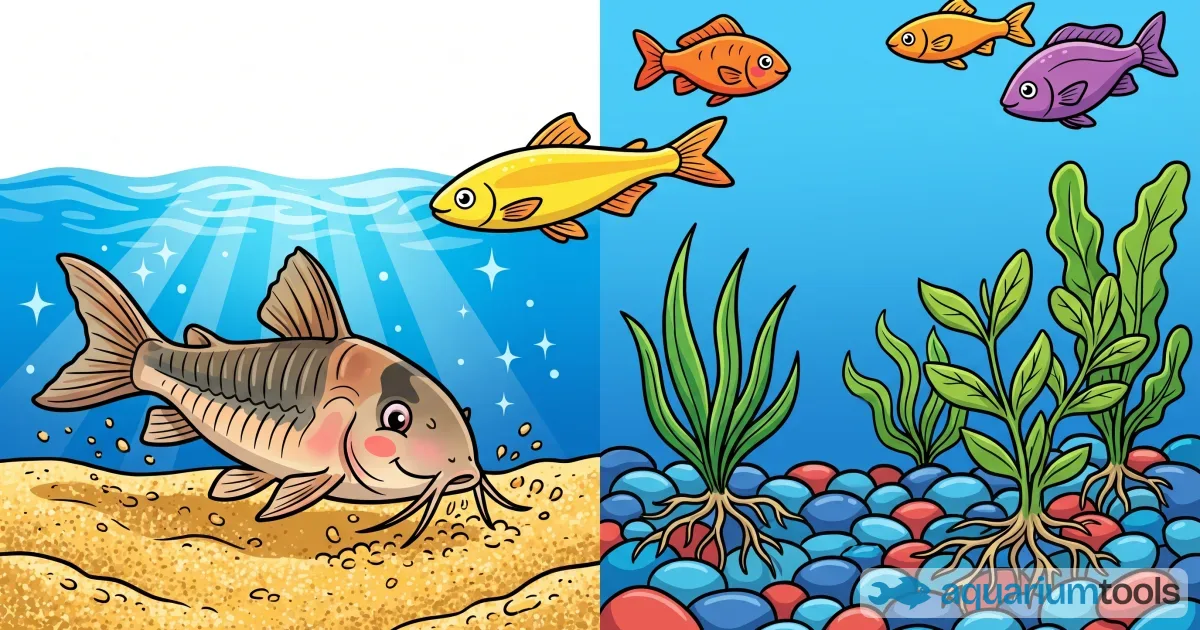
The aquarium substrate is not just a matter of aesthetics: it affects the health of the fish, the growth of plants and the efficiency of biological filtration. Choosing between sand and gravel is one of the first important decisions when setting up a tank, and there is no universal answer: it depends on the inhabitants, the style and the plants you want to grow. In this guide we analyse the pros and cons of both, with a focus on nutritive substrates and practical advice on grain size and colour.
Why the substrate really matters
The substrate performs several functions at the same time. It is the physical support for plant roots, it offers a huge surface for the colonisation of nitrifying bacteria (part of biological filtration), it affects the behaviour of many fish and it largely determines the final look of the tank. A wrong choice can cause recurring problems: toxic stagnation, difficulty in maintaining plants or injuries to bottom-dwelling fish.
Sand: elegance and naturalness
Sand offers a very natural look, similar to many freshwater and marine environments. The fine grains create a compact surface on which dirt tends to stay on top, making cleaning relatively simple: the residue is vacuumed by passing the siphon just above the substrate without sinking in too much.
The great advantage of sand concerns bottom-dwelling fish. Species such as Corydoras, loricariids and many fish that sift the substrate with their mouths benefit greatly from a fine, edge-free substrate: the barbels of corydoras, in particular, can wear down or become infected on coarse, sharp gravel.
The main disadvantage is the risk of anaerobic zones. If the sand layer is very thick and is never stirred, the deep portions may lack oxygen and hydrogen sulphide may form (recognisable by the smell of rotten eggs). For this reason a thin layer is recommended, or the presence of organisms that stir the substrate, such as certain snails.
Gravel: versatility and simplicity
Gravel is historically the most widespread substrate and remains an excellent all-round choice. The larger grains leave ample spaces between them, promoting water circulation and reducing the risk of anaerobic pockets. This structure also allows debris to slip between the grains, so siphoning must be deeper and more thorough.
Gravel is more stable and anchors robust plants and developed roots better. It is also compatible with most filters, including the rare configurations with an undergravel filter, where porosity is essential.
Be careful, however, with digging cichlids and fish that move the substrate: with these inhabitants you need gravel of an adequate size, neither too fine to be swallowed nor sharp.
Effect on plants and biological filtration
Both substrates host nitrifying bacteria well, provided water circulation is adequate. From the point of view of plants, however, there are differences. Compact fine sand retains nutrients in contact with the roots but can suffocate them if too dense; gravel promotes oxygenation but retains fewer nutrients in the root zone.
For an aquarium of demanding plants, inert sand and gravel are often not enough on their own: this is where nutritive substrates come into play.
Substrates specific to plants
Nutritive substrates (often called fertilised or allophane substrates) are formulated to gradually release nutrients and to promote root development. Many also have a buffering effect that tends to lower and stabilise pH and hardness, conditions favoured by numerous plants and by soft-water fish.
- Complete substrate (soil): an active compound used on its own, ideal for heavily planted or "nature aquarium" tanks. It lasts a few years.
- Base fertilised substrate: a nutrient-rich layer placed beneath a layer of gravel or inert sand, which keeps it in place.
- Tab/stick fertilisers: supplements to insert into inert substrate to feed plants with demanding roots.
A common and effective solution is the two-layer scheme: nutritive substrate on the bottom and sand or fine gravel as a cover. In this way you combine nourishment for the roots and aesthetics.
Grain size and colour: practical advice
Grain size affects cleaning, rooting and the safety of the fish. As a general reference:
- Fine sand (0.5–1 mm): ideal with corydoras and delicate bottom-dwelling fish.
- Fine gravel (1–3 mm): an excellent compromise for general planted aquariums.
- Medium gravel (3–5 mm): versatile, good circulation, suitable for many communities.
As for colour, dark substrates enhance the colours of the fish and give a natural look, reducing stress in many species. Light substrates brighten the tank but can wash out the fish and make dirt more visible. Avoid artificial and bright colours if you are aiming for a natural look.
Comparison table
| Criterion | Sand | Gravel |
|---|---|---|
| Aesthetics | Very natural, elegant | Versatile, classic |
| Maintenance | Dirt on the surface, light siphoning | Deeper siphoning |
| Bottom-dwelling fish (corydoras) | Ideal, does not injure the barbels | Risk of abrasions if coarse |
| Digging cichlids | Good, if the layer is not too thick | Good with adequate grain size |
| Plants | Retains nutrients but can compact | Good anchoring, less retention |
| Biological filtration | Excellent with good circulation | Excellent, great porosity |
| Risk of anaerobic zones | Higher if the layer is thick | Low |
How to choose based on your aquarium
If the heart of the tank is delicate bottom-dwelling fish, fine sand is the best choice. For a general community aquarium that is easy to manage, fine or medium gravel is an excellent base. For a heavily planted layout, go for a nutritive substrate, possibly covered with sand or fine gravel. For African cichlids, also consider substrates that raise hardness and pH.
FAQ
How much substrate do I need?
As a general rule, plan for about 3–5 cm of thickness, more in the rear planted areas for rooting and less in the foreground. For nutritive substrates, follow the manufacturer's instructions.
Can I put sand on top of gravel?
It is not advisable: sand tends to filter downwards between the grains. Better the other way around, that is, nutritive substrate or gravel underneath and sand on top, or well-separated layers.
Does sand damage the filter?
If sucked in, the fine grains can wear out the pump's impeller. Place the water intakes a few centimetres from the bottom and stir the sand gently during maintenance.
Should I wash the substrate before use?
Yes, rinse inert sand and gravel until the water runs clear to remove dust. Active nutritive substrates, on the other hand, should normally not be washed: always follow the manufacturer's instructions.
How often should I siphon the substrate?
For most home aquariums, siphoning the substrate once every 1 to 2 weeks during your routine partial water change is the sweet spot.
However, the exact frequency and technique depend heavily on what type of substrate you have and how your tank is set up.
Crucial Rule: Never siphon 100% of the deep substrate in a mature gravel bed all at once. Beneficial bacteria live on the gravel surfaces. Siphoning too aggressively in one go can trigger a mini-cycle (an ammonia spike) by stripping away your biological filtration. Clean 25–50% of the floor area per water change.
All material on this site is protected by copyright. Partial or total copying and republishing without authorization is not allowed.
Comments
Join the conversation
Create a free account to leave a comment. It only takes a minute and you'll come right back here.
No comments yet. Be the first to share your experience.