Takashi Amano: the father of modern aquascaping
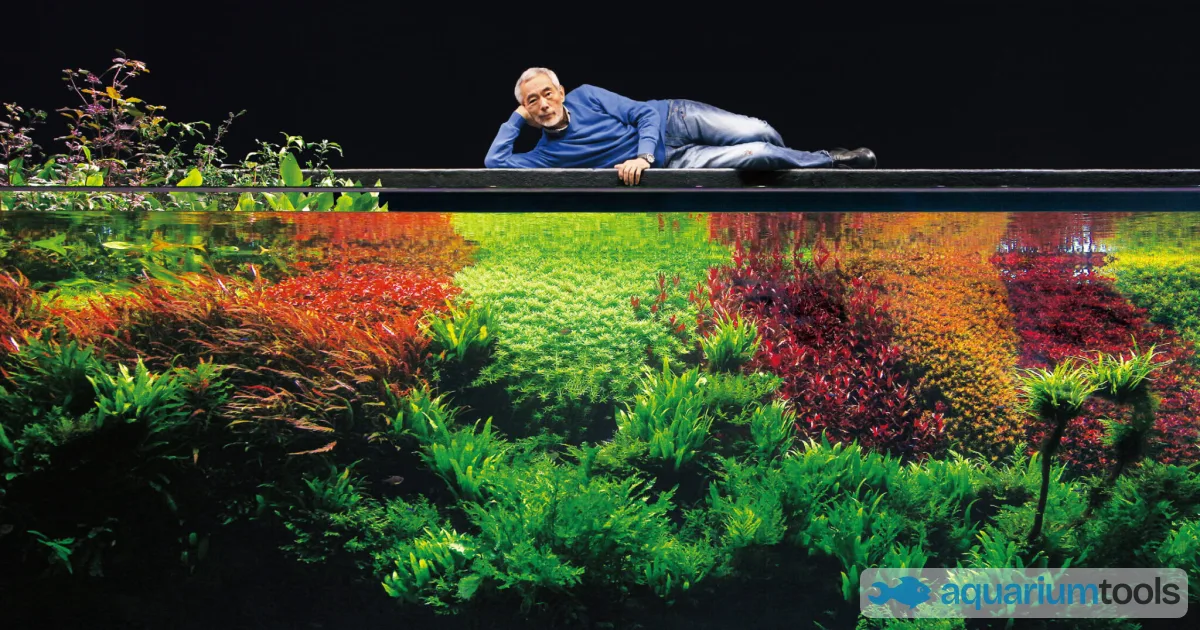
Few names have left their mark on the aquarium hobby like that of Takashi Amano. A photographer, traveller and nature lover, he was able to transform the home aquarium into a living canvas, bringing Japanese aesthetics into the water. Even today, anyone arranging stones, wood and plants according to an idea of landscape owes something to his vision.
From his early years to nature photography
Takashi Amano was born on 18 July 1954 in Niigata Prefecture, Japan. Before becoming a reference point for aquarists worldwide, he cultivated two passions that would deeply shape his work: sport and photography. As a young man he practised cycling at a competitive level, an experience that left him with rigour and discipline, qualities we will find again in his meticulous approach to setting up aquariums.
It was nature photography, however, that defined his artistic identity. Amano devoted much of his life to photographing primary forests and pristine environments all over the world, using bulky large-format cameras to capture every detail of the landscape. This eye, trained to read light, depth and natural compositions, became the foundation of the way he thought about the aquarium.
The birth of ADA and the Nature Aquarium style
In 1982 Amano founded in Niigata the company Aqua Design Amano, universally known by the acronym ADA. Through this venture he developed and spread what we know today as the Nature Aquarium: a style of aquascaping that does not aim to recreate a single scientific biotope, but to evoke the emotion and harmony of a natural landscape.
The inspiration came directly from Japanese culture and aesthetics. The sense of impermanence, the search for asymmetrical balance and the attention to empty space, principles close to the idea of wabi-sabi and to the tradition of Japanese gardens, translated into sober and elegant compositions. Amano's aquariums recalled riverbanks, clearings, mist-shrouded hills or submerged woods, always with a deep visual coherence.
Within this philosophy the Iwagumi style also developed, based on the arrangement of rocks alone as the main structural elements, with just a few plant species completing the scene. A layout that is seemingly simple, but among the most difficult to achieve, because each stone must find the right position as in a musical composition.
Technical innovation: CO2, substrates and plants
Amano was not only an artist, but also a populariser capable of making accessible techniques that were previously reserved for a few. He understood that a lush planted aquarium required a method, and he made a decisive contribution to spreading some tools now considered standard.
- CO2 injection: he promoted the use of carbon dioxide as a key factor for the healthy and vigorous growth of aquatic plants, when it was still an uncommon practice among hobbyists.
- Nutrient substrates: with the line of fertile soils developed by ADA, he helped spread the idea that the aquarium's substrate should actively nourish the roots, rather than being a simple inert support.
- Lighting and plant composition: he took care of the balance between light, nutrients and botanical species, showcasing foreground plants, mosses and wood covered in greenery.
His name is also linked to one of the most beloved invertebrates in the world of planted aquariums: the small freshwater shrimp known as the Amano shrimp (Caridina multidentata), which Amano made famous precisely for its effectiveness in controlling algae in a natural way.
The books and international spread
The wider Western public came to know his work above all thanks to the volumes of the Nature Aquarium World series, which collected his photographs of aquariums and spread his aesthetic well beyond the borders of Japan. Through these images of extraordinary quality, the aquarium ceased to be a simple container of fish to become a miniature landscape to contemplate.
To give this passion a competitive and community dimension, in 2001 ADA created the International Aquatic Plants Layout Contest (IAPLC), the international aquascaping competition that over the years has become the most prestigious event in the field, capable of gathering thousands of participants from every continent.
The last great work
Among the most ambitious works of his career is the creation of an enormous nature aquarium for the Lisbon Oceanarium, in Portugal, inaugurated in 2015. It is one of the most imposing installations ever conceived in this style, designed to give visitors the immersive experience of a submerged forest. It was, in a sense, the public crowning of his idea of the aquarium as a work of art accessible to everyone.
Takashi Amano passed away on 4 August 2015. His death left a deep void in the aquarium community, but his legacy continues to live and grow.
The legacy in the contemporary aquarium world
Today the term aquascaping has entered the everyday language of enthusiasts, and much of what we mean by this word descends directly from Amano's work. His insights redefined the relationship between the hobbyist and the aquarium:
- the idea that an aquarium can be designed like a landscape, with compositional rules borrowed from art and photography;
- the central role of plants and their well-being, supported by light, CO2 and suitable substrates;
- an aesthetic culture that values sobriety, balance and respect for nature observed first-hand.
Amano's aquarium does not imitate nature in its details, but captures its spirit, inviting the viewer to slow down and contemplate.
Whether you are a beginner or an expert layout builder, retracing the story of Takashi Amano is a way to understand why, every time we choose a stone, a piece of wood or a tuft of moss, we are taking part in a tradition that this Japanese photographer helped to found. His message remains relevant: behind a good aquarium there is not only technique, but a gaze capable of finding beauty in nature.
Sources
- Official Aqua Design Amano (ADA) website - adana.co.jp
- Encyclopaedia entry "Takashi Amano" - Wikipedia
- Oceanário de Lisboa, nature aquarium project - oceanario.pt
- Articles and in-depth features from specialised aquarium magazines (e.g. Practical Fishkeeping) on the work and legacy of Takashi Amano.
- Takashi Amano atop a massive aquarium. Photo courtesy of Aqua Design Amano (ADA)
Keep reading
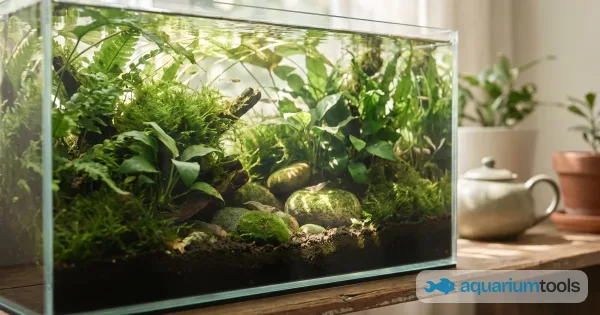
Diana Walstad and the Natural Method for the Planted Aquarium
A portrait of Diana Walstad, the American microbiologist and author who popularized the 'low-tech' approach to the planted aquarium based on biological balance, organic substrate and doing without injected CO2.
All material on this site is protected by copyright. Partial or total copying and republishing without authorization is not allowed.
Comments
Join the conversation
Create a free account to leave a comment. It only takes a minute and you'll come right back here.
No comments yet. Be the first to share your experience.