The Complete Guide to the Nitrogen Cycle
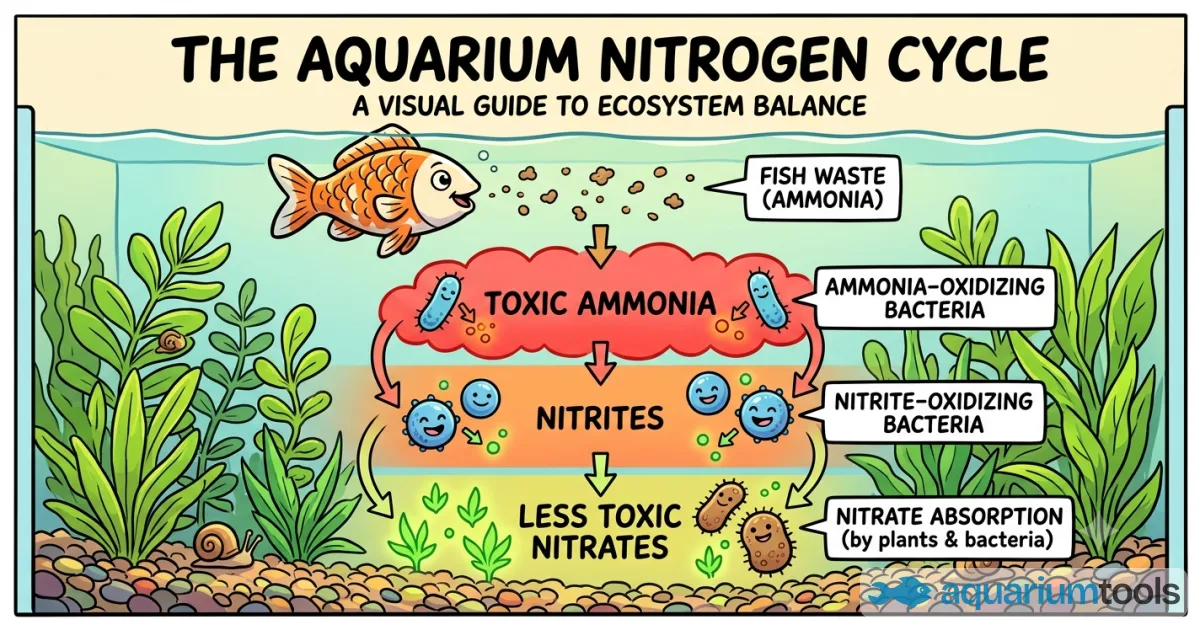
If you've just bought your first aquarium, you're probably itching to fill it with colourful fish. Hold on a moment: there's an invisible but essential step to complete first, and it's called the nitrogen cycle. Understanding it is the secret to avoiding most of the problems (and disappointments) that beginners face. In this guide I'll explain everything simply, with easy analogies and a practical roadmap.
What the nitrogen cycle is (explained simply)
Picture your aquarium as a small, closed house. Fish eat, breathe and produce waste; uneaten food and dead plants also decompose. All of this generates a highly toxic substance: ammonia. In a lake or a river there's plenty of water and the waste is diluted; in your aquarium, however, space is limited and ammonia builds up quickly until it becomes lethal.
The nitrogen cycle is your aquarium's natural waste disposal system. You don't manage it directly: microorganisms do. Think of them as a little army of invisible cleaners that turn poison into something far less dangerous.
The three stages of the cycle
- Ammonia (NH₃/NH₄⁺): the starting waste, highly toxic even at low concentrations.
- Nitrites (NO₂⁻): still toxic, produced by a first group of bacteria that "eat" the ammonia.
- Nitrates (NO₃⁻): the final product, far less dangerous, which builds up slowly and is removed with water changes.
In short: ammonia → nitrites → nitrates. Each arrow represents the work of a different group of bacteria.
The role of nitrifying bacteria
The stars of the whole story are the nitrifying bacteria. These are beneficial microorganisms that colonise mainly the filter media, the substrate and the aquarium surfaces. They can't be seen with the naked eye, but without them your aquarium simply cannot function.
- A first group converts ammonia into nitrites.
- A second group converts nitrites into nitrates.
The important point is this: these bacteria don't appear out of nowhere in a single day. They have to arrive, multiply and form colonies large enough to process everything the fish produce. This process takes time, usually several weeks. "Cycling" the aquarium means precisely giving these bacteria the time and food they need to establish themselves before you introduce the fish.
Golden rule: you don't put fish in a freshly set-up aquarium. First you create the environment, then you add the inhabitants.
Why start the cycle before adding fish
If you put fish in an uncycled aquarium, the ammonia and then the nitrites they produce aren't processed by anyone. Concentrations rise rapidly and the fish become poisoned: burned gills, breathing difficulties, stress and, very often, death within a few days. This is the infamous "new tank syndrome", one of the leading causes of failure among beginners.
Cycling in advance means building the disposal system first and only then bringing in the tenants. It takes more patience, but it's the only way to truly start off on the right foot.
Practical cycling timeline
Timings vary depending on temperature, the method used and a bit of luck, but this week-by-week table gives you a realistic reference for a fishless cycle (the safest method).
| Phase | What happens | What you do |
|---|---|---|
| Week 1 | You add a source of ammonia. Still no visible bacterial activity. | Set up the aquarium, start the filter and heater, dose the ammonia. |
| Week 2 | Nitrites start to appear: the first bacteria are at work. | Test ammonia and nitrites; keep up the ammonia source. |
| Week 3 | Ammonia drops, nitrites peak and nitrates begin to appear. | Continue testing every 2-3 days; don't be discouraged if nitrites are high. |
| Week 4-6 | Ammonia and nitrites fall to zero, nitrates rise. | Do a large water change to lower the nitrates, then add your first fish gradually. |
The cycle is considered complete when, after adding ammonia, within 24 hours both ammonia and nitrites return to zero and you find only nitrates. This is the sign that the bacterial colonies are now efficient.
How to test your water values
Without tests, the cycle is invisible: you might not notice what's going on. That's why you need testing kits. Liquid reagent tests are generally more accurate than strips.
The three values to monitor during cycling are:
- Ammonia: should rise and then drop to zero.
- Nitrites: rise after the ammonia, reach a peak and then return to zero.
- Nitrates: appear last and keep accumulating (managed with water changes).
During cycling it's best to test every 2-3 days to follow the progression. Seeing ammonia fall as nitrites rise, and then nitrites fall as nitrates rise, is the visual confirmation that the bacteria are working.
Methods to speed up the cycle
1. Fishless cycling
This is the recommended method: you add a source of ammonia yourself (pure ammonia with no additives, or by letting a little food decompose) to feed the bacteria, without putting any animal at risk. Safe and ethical.
2. Bottled bacteria
There are commercial products based on live bacterial cultures that you pour into the aquarium. They can give an initial boost and shorten the timeline, though effectiveness varies from product to product. Store them correctly and use them before the expiry date: "dead" bacteria are useless.
3. Mature filter media
The single most effective method. If you (or a friend) have an already established and healthy aquarium, you can transfer some of the filter media or a handful of substrate: they're already full of bacterial colonies ready to use. Be careful to take material only from aquariums that are definitely healthy, so you don't import diseases.
4. Temperature and oxygen
Nitrifying bacteria work better in warm (roughly 25-28 °C) and well-oxygenated water. Good surface movement and keeping the filter always on speed up the process. Never turn off the filter: the bacteria need constant oxygen and flow.
The most common mistakes to avoid
- Adding fish too soon. This is mistake number one. Patience here is worth more than any product.
- Not testing the water. Without a testing kit you're flying blind and can't really tell whether the cycle is complete.
- Washing the filter with tap water. Chlorine kills beneficial bacteria. Rinse sponges only in the water removed during a water change.
- Turning off the filter at night or for long periods. Without oxygen and flow the colonies suffer and can die.
- Changing too much water or replacing all the filter media at once. You risk removing most of the bacteria and restarting the cycle from scratch.
- Overstocking straight away. Even after cycling, add just a few fish at a time: the bacterial colonies need to adjust to the new load.
- Overfeeding. Excess food means more waste, more ammonia and more stress on the system.
In summary
The nitrogen cycle isn't complicated: it's simply the process by which good bacteria learn to turn toxic waste into manageable substances. All you need to remember is the sequence ammonia → nitrites → nitrates, give the bacteria time to establish themselves, test the water regularly and resist the temptation to add fish too soon. A few weeks of patience at the start will reward you with a stable, healthy aquarium free of nasty surprises. Happy cycling!
All material on this site is protected by copyright. Partial or total copying and republishing without authorization is not allowed.
Comments
Join the conversation
Create a free account to leave a comment. It only takes a minute and you'll come right back here.
No comments yet. Be the first to share your experience.