The 5 best aquarium plants for beginners (with no CO2)
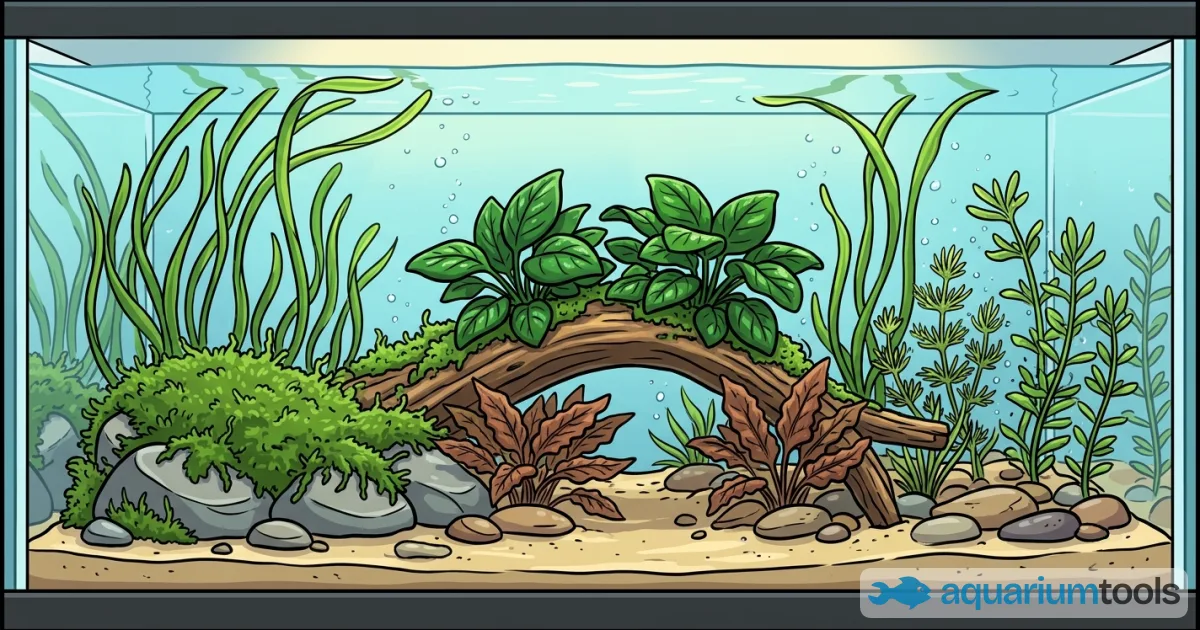
Starting a planted aquarium without a CO2 system isn't a compromise: it's a smart choice. There's a group of plants that grow beautifully under modest lighting, tolerate beginner mistakes and instantly deliver a look worthy of a mature tank. As an aquascaper, these are the five I put in every "low tech" project when I want safe, high-impact results.
1. Anubias: the indestructible green rock
Anubias (especially Anubias barteri var. nana and the "Petite" version) are the most forgiving plants of all. Thick, dark green, glossy leaves: they immediately give a solid, tidy feel.
The secret is just one: never bury them. The rhizome " that horizontal stem from which roots and leaves emerge " must stay exposed, otherwise it rots. Tie it to a rock or piece of wood with cotton thread or a drop of cyanoacrylate glue (super glue gel). Place them at medium height, in partial shade: too much direct light encourages algae on the very slow-growing leaves. They're also perfect in aquariums with digging fish, since they don't need substrate.
2. Java Moss: the carpet and the detail
Java moss (Taxiphyllum barbieri) is the most versatile tool for giving maturity to a layout. It creates texture on wood and rocks, softens sharp corners and offers shelter to fry and shrimp.
To anchor it, spread a thin layer over the surface and fix it with transparent fishing line or a mesh; this avoids unsightly "balls". It grows in any light condition, but current is its friend: a good flow brings nutrients and keeps the branches clean of debris. Trim it with scissors when it gets too thick, otherwise the inner part yellows from lack of light.
3. Vallisneria: movement in the background
If you want that "waving meadow" effect at the back of the tank, Vallisneria is unbeatable. Its long ribbon-like leaves create depth and follow the current in a hypnotic way, ideal for tall aquariums.
Plant the individual tufts in the substrate leaving the crown (the white part between roots and leaves) just above the sand: if you bury it, the plant suffers. It propagates on its own via runners, so start with a few plants and let them colonise the background. It appreciates neutral to slightly hard water; a fertile substrate or a few root sticks speed up growth. When a leaf reaches the water's surface, shorten it at the base instead of cutting it in half.
4. Cryptocoryne: colour for the midground
Cryptocoryne (the wendtii in its green, brown and red variants is perfect for getting started) are the queens of patience. Wavy leaves and warm tones beautifully fill the central zone, between the foreground wood and the tall plants at the back.
They are buried in the substrate, roots below and crown at the surface. Be prepared for the so-called "crypt melt": after transplanting, many leaves may dissolve. Don't tear them off and don't throw the plant away: the rhizome is alive and pushes out leaves adapted to the new conditions within a few weeks. Once settled they are practically eternal and only hate frequent moves, so choose their spot well from the start.
5. Hygrophila: the rapid growth that saves you
Hygrophila (Hygrophila polysperma or Hygrophila corymbosa) is the plant I recommend to "win the algae war" in the first months. It grows quickly, rapidly consumes excess nutrients and fills the gaps in the background while the slower plants take hold.
It's planted as single stems, spaced a couple of centimetres apart, in the substrate. When it reaches the desired height, cut the top and replant it: you get new plants for free and an ever-denser bush. Speed comes at a price: it requires regular trimming so it doesn't shade its neighbours. It's also a great indicator " if the new leaves turn pale, the tank is asking for a little iron or a complete fertiliser.
Practical tips to start off right
- Moderate light, constant photoperiod: 6"8 hours a day with a timer. More light without CO2 just means more algae.
- Plant densely from the start: a tank full from the beginning leaves little room for algae and reaches balance sooner.
- Light liquid fertiliser: even without CO2, plants need micronutrients. A few ml a week make the difference.
- Patience in the first weeks: melt, old leaves dropping and slow growth are normal. The tank really "lights up" after the first month.
With these five plants you can build a complete layout " foreground, midground and background " without cylinders, without diffusers and without anxiety. They're the foundation on which I've seen hundreds of beautiful aquariums born: pick three or four, pair them with a good piece of wood and let them do their job. Nature, if you put it in the right conditions, does almost everything on its own.
All material on this site is protected by copyright. Partial or total copying and republishing without authorization is not allowed.
Comments
Join the conversation
Create a free account to leave a comment. It only takes a minute and you'll come right back here.
No comments yet. Be the first to share your experience.