Aquarium Maintenance: What to Do Every Week, Month and Year
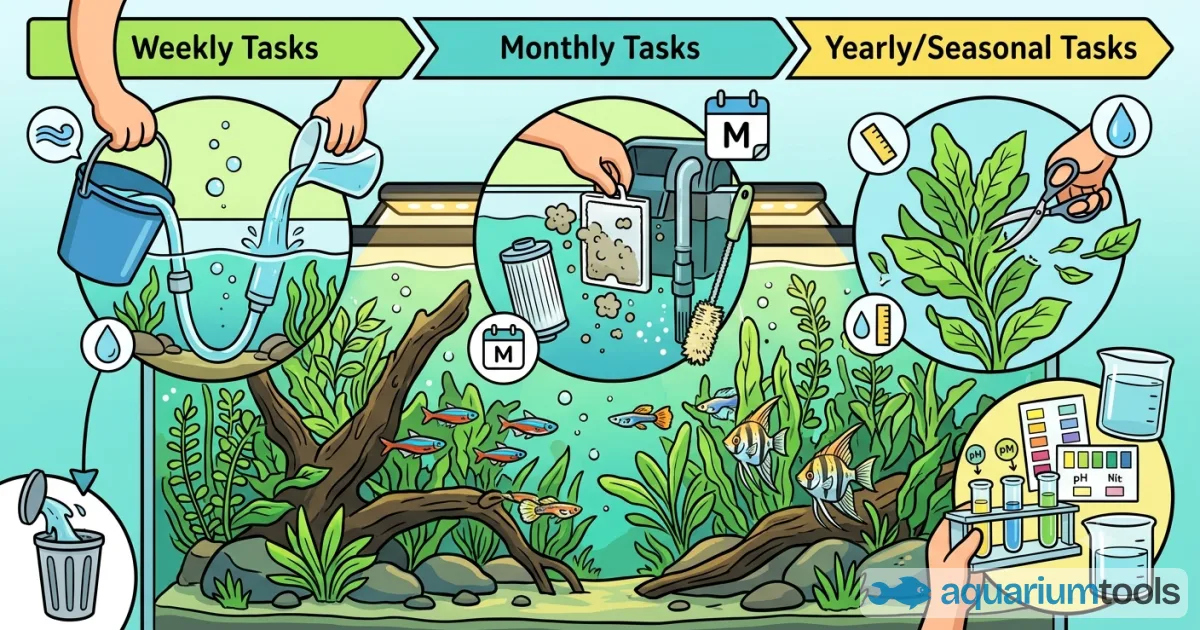
A stable aquarium isn't achieved through sporadic interventions, but with a consistent routine well distributed over time. The basic rule is simple: many small regular actions are better than a few drastic operations. Here you'll find a schematic checklist organised by frequency, designed for those who want to act right away without wasting time.
Every week: the routine that saves the balance
Weekly tasks are the heart of maintenance. They're quick but decisive for keeping nitrates under control and keeping the environment stable.
- Partial water change (10-30%): vacuum the substrate with a siphon to remove debris and food residue, then top up with water at a similar temperature. You never empty the entire aquarium: in the substrate, on the glass and above all in the filter sponges live the nitrifying bacteria that turn toxic ammonia into nitrites and then into nitrates. Emptying everything wipes out this colony and restarts the cycle from scratch, exposing the fish to toxic spikes.
- Water conditioner: if you use tap water, always add a bioconditioner to neutralise chlorine and chloramines, which are lethal to bacteria and to the fish's gills.
- Glass cleaning: remove algae from the front glass with a magnet or a scraper before the water change, so you vacuum up the dirt you've loosened.
- Quick check: verify the temperature, count your animals and check that the filter and heater are working. Watch the fish's behaviour: it's the first indicator of a problem.
- Removing excess food: clear away any residue on the bottom so you don't fuel ammonia spikes.
Every month: monitoring and deep cleaning
Monthly operations serve to keep an eye on the parameters and to keep the filtration system efficient.
- Cleaning the filter sponges: this is one of the most delicate points. The sponges should be squeezed and rinsed strictly in aquarium water (the water drawn off during the change), never under the tap. The chlorine and the temperature difference of running water would kill the bacterial flora. Clean one section of the filter media at a time, not all of it at once, to preserve the bacteria.
- Checking the water parameters: measure at least pH, KH (carbonate hardness), GH, nitrites (NO\u2082) and nitrates (NO\u2083). Liquid reagent tests are more reliable than test strips. Note the results in a notebook or an app: seeing the trend over time helps prevent problems.
- Pruning the plants: trim yellowed or damaged leaves, shorten stems that are too tall and thin out fast-growing species. Healthy plants compete with algae for nutrients and oxygenate the water.
- Replacing consumable media: change the activated carbon or resins if used, following the manufacturer's instructions.
Every year: scheduled checks and replacements
Some tasks are done rarely but are essential for the equipment's lifespan and long-term health.
- Replacing the lamps: T5/T8 tubes lose intensity and shift the spectrum towards wavelengths that favour algae. LED light fixtures last longer, but should still be checked.
- External filter maintenance: dismantle it, rinse the impellers, check the seals and hoses. Replace worn parts to avoid leaks or drops in flow rate.
- Checking the equipment: verify the heater, thermometer, pumps and timers. A faulty heater is one of the most common causes of sudden problems.
- Partial replacement of the nutrient substrate: in planted tanks, the nutrient substrate becomes depleted. Supplement it with fertiliser tablets or plan a partial renewal.
The guiding principle
Stability always beats perfection. Small, regular interventions keep the ecosystem in balance better than any drastic cleaning.
By following this schedule you'll have a clear aquarium, healthy fish and thriving plants, while minimising surprises. Adapt the frequencies to the size of the tank and the population load: a heavily stocked tank will require more frequent changes, while a mature, lightly populated aquarium can tolerate slightly longer intervals.
All material on this site is protected by copyright. Partial or total copying and republishing without authorization is not allowed.
Comments
Join the conversation
Create a free account to leave a comment. It only takes a minute and you'll come right back here.
No comments yet. Be the first to share your experience.