Managing Your Aquarium in Summer: How to Lower the Temperature
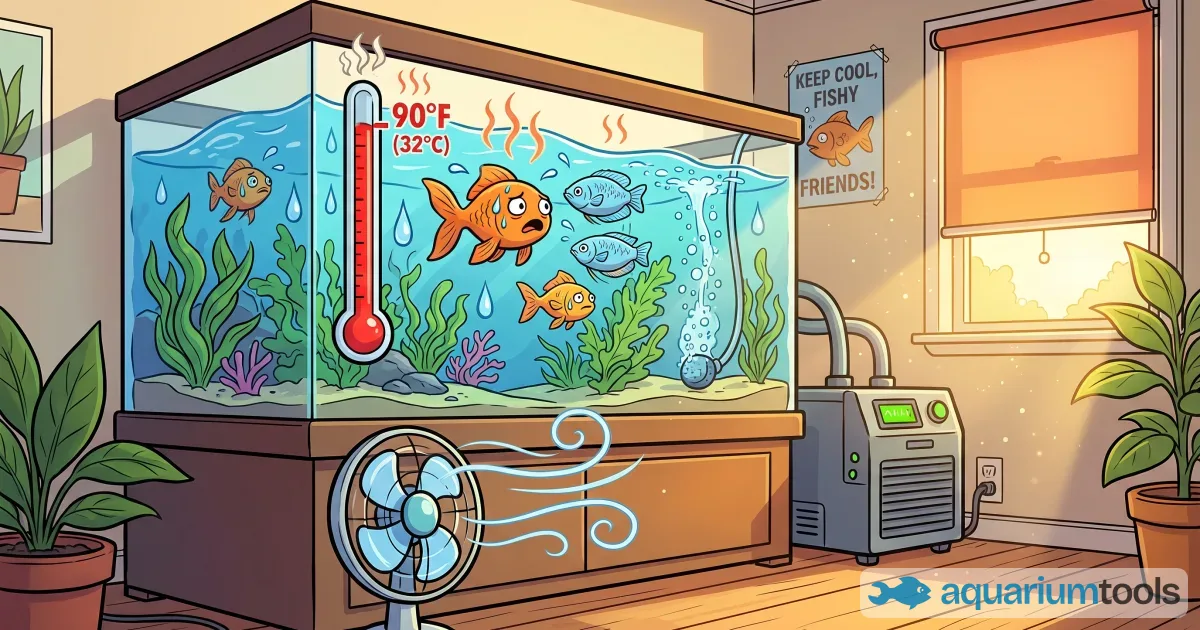
The summer months put every aquarium to a hard test. When the room temperature rises, the water temperature follows quickly, and within a few hours the tank can reach critical values. Most tropical aquarium fish thrive between 24 and 26 °C: staying consistently above 28-30 °C means exposing the animals to growing stress and, in the worst cases, death. In this guide we look at why heat is dangerous and which measures to take, from the simplest and cheapest to professional solutions.
Why high temperatures are dangerous
The main problem is dissolved oxygen. Warm water holds less oxygen than cold water: the higher the temperature rises, the less O₂ is available for fish, invertebrates and beneficial bacteria. It's a cruel paradox, because in the heat the fish's metabolism speeds up and their oxygen demand increases precisely when the water offers less of it.
On top of this comes thermal stress: laboured breathing near the surface, erratic swimming, reduced appetite and a weakened immune system. A stressed fish is far more vulnerable to diseases and parasites.
Finally, heat promotes bacterial proliferation and speeds up the decomposition of organic waste. This can lead to spikes in ammonia and nitrites, sudden cloudiness and a general worsening of water quality at the most delicate moment.
The solutions, ranked by effectiveness and cost
1. Positioning and reducing heat sources
The first move costs nothing and is often the most overlooked. An aquarium exposed to direct sunlight or near radiators, hot appliances or south-facing windows overheats far more easily. If possible, choose a sheltered location; if the tank cannot be moved, close curtains and blinds during the hottest hours to shield it from direct light.
Pay attention to the lid as well: keeping it closed limits evaporation but traps heat and humidity. In summer it can be useful to open it partially or remove it, which also encourages gas exchange with the air.
2. Reducing lighting
Lights, especially old tubes and incandescent spotlights, release direct heat into the water. On scorching days you can reduce the hours they stay on and shift the photoperiod to the cooler hours, for example evening and night. LEDs heat up far less than traditional fixtures, but they too contribute if left on for a long time. Raise the light fixture a few centimetres above the surface to reduce heat transfer.
3. Extra aeration
Since the real risk is oxygen shortage, increasing oxygenation is a fundamental and inexpensive countermeasure. An aerator with an air stone or a more vigorous surface movement improve gas exchange. You can point the filter outlet upwards to increase surface rippling: that's where most of the oxygen exchange takes place. This move doesn't lower the temperature, but it noticeably reduces stress on the fish.
4. Aquarium fans
Fans are the best compromise between cost and effectiveness for most home aquariums. Mounted on the rim of the tank, they blow air across the water surface and promote evaporative cooling. Depending on ambient humidity and the number of fans, you can achieve temperature drops of around 2-4 °C.
Advantages: low price, low power consumption, easy installation. Disadvantages: evaporation increases, so you'll need to top up more often with water low in mineral salts (reverse osmosis or water suited to your system) to avoid raising the hardness. Many fans can be paired with a thermostat that switches them on only above a certain temperature.
5. Chillers
The chiller is the most effective and reliable solution, but also the most expensive. It works like a small air conditioner for the water: it maintains the set temperature with great precision, regardless of the outside climate. It's practically indispensable for reef marine aquariums, for high-value tanks or in areas with very long, hot summers.
It must be sized according to the tank's volume and installed with a dedicated pump. The drawbacks are the purchase cost, the electricity consumption and the fact that it expels heat into the surrounding environment. For those who don't want to worry about heat waves, however, it remains the definitive investment.
Emergencies: what to do during a heat wave
When the temperature suddenly shoots up and you don't have dedicated equipment, you can step in with last-minute remedies. The golden rule is to avoid abrupt swings: cooling that is too rapid is as dangerous as the heat.
- Ice bottles: freeze water in clean, sealed plastic bottles, then float them in the tank or sump. Melting slowly, they lower the temperature gradually. Never pour ice or cubes directly into the water.
- Household fan: aimed at the water surface, it replicates the effect of aquarium fans and is immediate.
- Turn off the lights and minimise every heat source around the tank.
- Maximum aeration: add an aerator or increase surface movement to compensate for the drop in oxygen.
- Partial water change with slightly cooler water (never ice cold): 10-20 % can help, proceeding slowly.
- Don't overfeed: uneaten food worsens water quality and consumes oxygen as it decomposes.
- Ventilate the room during the cool hours of morning and evening, keeping it closed and shaded during the day.
Always keep an eye on the fish's behaviour: if they gasp at the surface, oxygen shortage is already underway and you need to act immediately on aeration.
Summer checklist
- Move or shield the tank from direct sun and heat sources.
- Reduce lighting hours and shift the photoperiod to the evening.
- Raise the light fixture and open the lid partially.
- Increase aeration and surface water movement.
- Install one or more aquarium fans, ideally with a thermostat.
- Consider a chiller for high-value tanks, marine setups or very hot climates.
- Check the temperature several times a day with a reliable thermometer.
- Top up evaporated water to stabilise the values.
- Keep ice bottles ready in the freezer for emergencies.
- Reduce feeding and observe the fish's behaviour daily.
With a bit of prevention and the right tools, summer becomes manageable for the aquarium too. The key is to act in advance, monitor the temperature constantly and always remember that, in the heat, oxygen is the real resource to protect.
All material on this site is protected by copyright. Partial or total copying and republishing without authorization is not allowed.
Comments
Join the conversation
Create a free account to leave a comment. It only takes a minute and you'll come right back here.
No comments yet. Be the first to share your experience.