Aquarium on Vacation: A Practical Guide to Being Away for 2 Weeks Without Risks
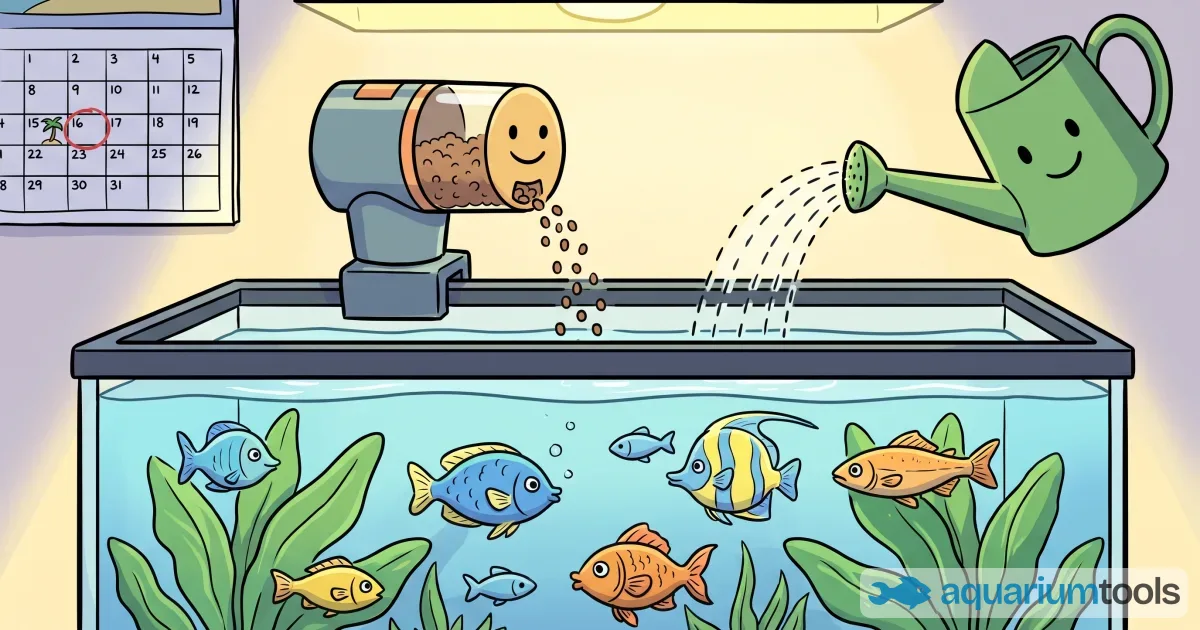
Leaving your aquarium on its own for two weeks is one of the most common worries among aquarium keepers. The good news is that a mature, well-prepared ecosystem tolerates your absence far better than you might think. The secret is not luck, but advance planning and automation tested ahead of time. In this guide you will find a practical path to prepare both the tank and your peace of mind.
1. The golden rule: plan ahead
The most common mistake is cramming all the major maintenance into the day before departure. That is exactly what you should not do. A large water change, a deep filter cleaning or replacing the filter media right before your trip can destabilise the bacterial flora, with the risk of an ammonia or nitrite spike precisely when you are not there to intervene.
The ideal timing is to complete every important task 7-10 days before departure. This margin lets you observe the tank, verify that the parameters have stabilised and calmly correct any anomalies. An aquarium left in balance for a week is far more reliable than one that has just been disturbed.
The fewer things you do right before leaving, the more stable the system will be while you are away.
2. Technical checklist: preparing the tank
Feeding
The best solution of all remains the help of a trusted person: an aquarium sitter, whether a neighbour or a relative. As an alternative, or as backup, automatic feeders come into play.
- Test the dispenser before you leave. Run it for at least 4-5 days while you are still at home, to verify the dose delivered with each cycle and its consistency.
- Use suitable food. Prefer dry granules or pellets of uniform size; avoid flakes that are too light and foods that absorb moisture, because they can swell and clog the mechanism.
- Keep the fan/aeration working. Many feeders have a small airflow passage to keep the food dry: make sure it is not blocked.
Let's debunk a myth: healthy adult fish tolerate fasting far better than excess food. For a well-established tank, a few days without meals are no problem, whereas overfeeding produces residues that rapidly degrade water quality. When in doubt, less is better than more.
Lighting
Maintaining a regular photoperiod is essential to avoid algae outbreaks and stress to plants. Rely on an analogue or digital timer, or a smart plug. Set a constant cycle (generally 6-8 hours for a planted freshwater tank) and check that it switches correctly before you leave.
Water management and evaporation
Over two weeks, evaporation can noticeably lower the water level. There are two consequences: the pump risks running dry and, especially in a marine aquarium, the salt concentration increases as the water evaporates. An automatic top-off (ATO) system solves both problems by replenishing only RO water. If you do not have an ATO, reduce the risk level by slightly lowering the room temperature and partially covering the tank to limit evaporation.
Filtration and temperature
About a week before, carry out a preventive cleaning of the mechanical sponges by rinsing them in tank water, without ever touching the ceramic rings and biological media, which host the nitrifying bacteria. A clean filter with its bacterial colony intact will work without clogging for the whole of your absence.
Finally, check that the heater (and the chiller in summer) is working properly and check the expected room temperature. In summer a closed room can overheat: consider a fan or leave a shutter lowered to limit the peaks.
3. Mental preparation and safety
Overcoming control anxiety
The biggest obstacle is often not technical, but psychological. The best way to leave with peace of mind is to have tested all the automation in advance: if the feeder, timer and top-off have worked for days under your own eyes, you can trust that they will keep doing so. Preparation is the real antidote to anxiety.
Briefing the aquarium sitter
If you rely on a person, leave nothing to chance. The number one risk is well-intentioned overfeeding.
- Prepare the single food doses in advance, already portioned (bags or containers with the days written on them): this way the sitter only has to pour, without deciding the amounts.
- Leave simple, clear written instructions, ideally with photos of the tank under normal conditions.
- Provide the emergency contacts of your trusted aquarium shop, so they can ask for help if in doubt.
Wi-Fi surveillance cameras
A small Wi-Fi camera allows remote visual monitoring without stress. Position it so it frames the water level, the fish behaviour and the lights turning on. A quick glance once a day is enough: avoid checking constantly, the goal is peace of mind, not anxiety.
The 7-days-before checklist
| When | What to do |
|---|---|
| 7-10 days before | Partial water change and cleaning of mechanical sponges (never the ceramic rings) |
| 7 days before | Parameter tests (ammonia, nitrites, nitrates, pH); start automatic feeder trial |
| 5-7 days before | Check light timer, heater/chiller and automatic top-off |
| 3 days before | Prepare single food doses for the sitter and install the Wi-Fi camera |
| 1 day before | Final check of levels, temperature and operation of all the automation |
| Day of departure | One last look at the tank, no invasive intervention |
In summary
Managing your aquarium on vacation for 14 days or more is absolutely possible without manual maintenance, provided you carry out the work in advance, test every piece of automation and, if necessary, rely on a well-briefed sitter. A stable ecosystem, controlled feeding, a regular photoperiod and an automatic top-off are the formula for leaving with peace of mind and finding the tank in full health on your return.
All material on this site is protected by copyright. Partial or total copying and republishing without authorization is not allowed.
Comments
Join the conversation
Create a free account to leave a comment. It only takes a minute and you'll come right back here.
No comments yet. Be the first to share your experience.