How to Feed Your Fish Correctly
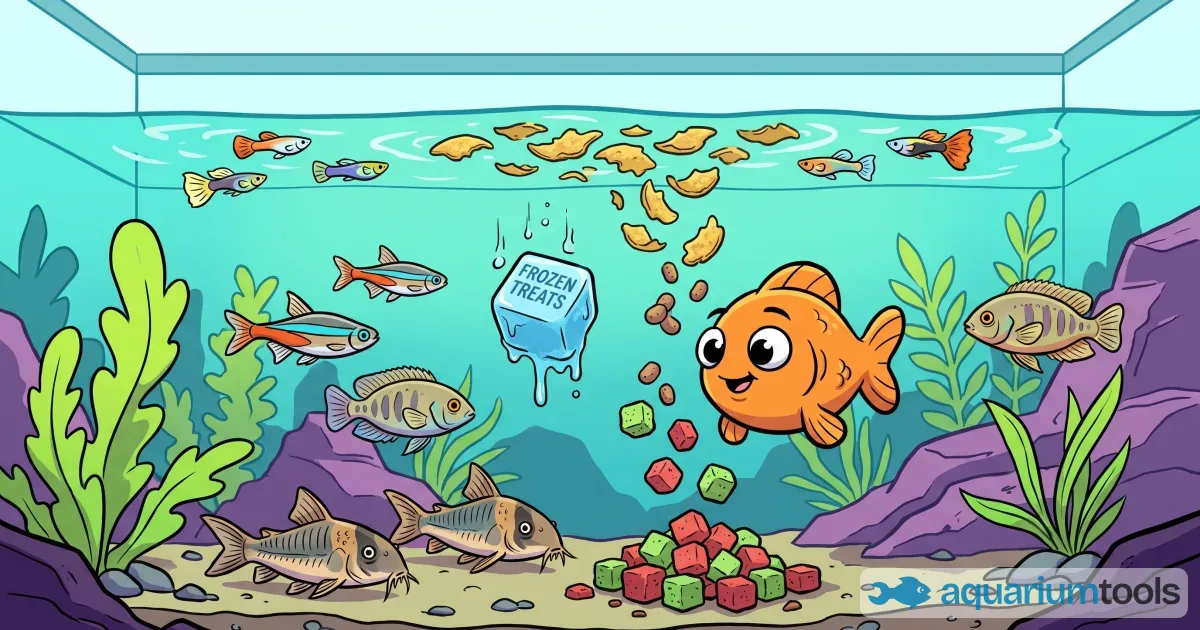
Feeding fish seems like the simplest task in the aquarium hobby, but it's also one of the most common mistakes. Improper feeding compromises fish health and water quality more than you might imagine. In this guide we look at the differences between the main types of food, when to use them and, above all, how to avoid overfeeding.
The main types of fish food
There's no perfect "universal" food: the choice depends on the species, their feeding habits (herbivorous, carnivorous, omnivorous) and the zone where they feed in the aquarium. Let's look at the five most common formats.
Flake food
This is the classic aquarium food, light and floating, suited to fish that feed at the surface or in mid-water.
- Pros: inexpensive, easy to find, available in specific formulations (for tropical fish, for coloration, spirulina for herbivores).
- Cons: it crumbles and fouls the water if given in excess; it quickly loses its vitamins once the package is opened.
- Suitable for: guppies, platies, tetras, danios and most small community fish.
Pellet food
Available in floating or sinking versions and in different sizes, it's more concentrated and less messy than flakes.
- Pros: more precise dosing, less dispersion, excellent for medium and large fish.
- Cons: you need to choose the right pellet size for the fish's mouth; sinking pellets can go unnoticed and decompose on the bottom.
- Suitable for: cichlids, goldfish, corydoras and bottom-dwelling fish (with sinking pellets), large fish.
Frozen food
These are foods like brine shrimp, bloodworms (mosquito larvae), daphnia and mysis, deep-frozen in blister packs. They provide an excellent source of natural protein.
- Pros: very palatable and nutritious, stimulates natural hunting behaviors, useful for conditioning for breeding.
- Cons: requires freezer space and must be thawed before use; it should not be re-frozen once thawed.
- Suitable for: almost all carnivores and omnivores, such as bettas, cichlids, coldwater fish and many marine species.
Freeze-dried food
These are the same organisms as frozen food (brine shrimp, tubifex, bloodworms) but dehydrated, therefore light and long-lasting.
- Pros: practical, keeps for a long time, retains much of its nutritional value.
- Cons: it tends to float and expand in the stomach; it's best to rehydrate it in a little tank water before feeding, to reduce the risk of digestive problems and bloating.
- Suitable for: as an occasional supplement for bettas, tetras, cichlids and many community fish.
Live food
This includes brine shrimp, daphnia, mosquito larvae, bloodworms and microworms. It's the most natural food of all.
- Pros: highly nutritious and stimulating, ideal for breeding conditioning and for fish that are difficult to wean.
- Cons: it can introduce parasites or pathogens if of uncertain origin; it requires culturing or frequent purchases.
- Suitable for: fry, predatory fish, bettas and species intended for breeding.
How much and how often to feed
The golden rule is simple: give only the amount the fish consume in 1-2 minutes. Anything left on the bottom is excess food.
- Tropical community fish: 1-2 times a day, small portions.
- Large fish and cichlids: often once a day is enough.
- Goldfish: 1-2 small rations a day, avoiding excess.
- Bottom-dwelling fish (corydoras, plecostomus): sinking pellets in the evening, when the lighting is off.
- Fry: several meals a day in very small doses, because they have a fast metabolism.
A useful tip is to vary the diet throughout the week: a base of quality flakes or pellets, supplemented 2-3 times a week with frozen or freeze-dried food. Many aquarists also observe one fasting day a week, which aids digestion and does no harm to healthy adult fish.
The risks of overfeeding
Overfeeding is probably the number one cause of problems in the aquarium. Fish, by instinct, eat even when they don't need to, so their hunger is not a reliable indicator of the correct amount.
Deterioration of water quality
Uneaten food decomposes on the bottom, feeding bacteria and algae. This raises nitrates, encourages algal blooms and can make the water cloudy or foul-smelling. Excess feces, produced by overfed fish, also contribute to the organic load.
Ammonia and nitrite spikes
The decomposition of food produces ammonia (NH3/NH4+), which is highly toxic. In a well-established tank the biological filter converts it into nitrites and then nitrates, but a sudden excess of food can exceed the bacteria's capacity and generate toxic spikes. This is a particularly serious risk in new tanks, where the nitrogen cycle is not yet stabilized.
Obesity and health problems
As with pets, excess food leads to the buildup of fat around the organs, compromising the liver and digestive system. Obese fish live shorter lives, breed with difficulty and are more exposed to disease. Fatty foods like bloodworms should be given in moderation.
How to recognize the signs
- Food residue on the bottom a few minutes after the meal.
- Cloudy water, with foam on the surface or a bad smell.
- Rapid proliferation of algae on the glass and decorations.
- Ammonia or nitrite levels above zero in water tests.
- Apathetic fish, with an unusually swollen abdomen or difficulty swimming.
- A sudden increase in the number of snails, often a sign of excess food.
What to do in case of overfeeding
If you notice these symptoms, act immediately:
- Stop or drastically reduce feeding for one or two days.
- Remove food and debris from the bottom with a net or a siphon.
- Perform a partial water change (20-30%) with water at a suitable temperature.
- Check ammonia, nitrites and nitrates with a reliable test.
- Clean the filter only if necessary and without destroying the bacterial colony.
Practical tips to apply right away
- Estimate small portions by eye: it's always better to give a little and observe.
- Store food in a cool, dry place, closing the packages well.
- Throw away old food: a few months after opening it loses its nutritional value.
- If you're away for a few days, healthy adult fish tolerate fasting well: it's better not to leave excess food with someone inexperienced.
- Watch your fish every day during the meal: it's the best time to notice changes in behavior or health.
Feeding correctly means providing variety, measured amounts and regularity, without ever overdoing it. A balanced diet is the foundation for healthy fish, vibrant colors and a clear, stable aquarium over time.
All material on this site is protected by copyright. Partial or total copying and republishing without authorization is not allowed.
Comments
Join the conversation
Create a free account to leave a comment. It only takes a minute and you'll come right back here.
No comments yet. Be the first to share your experience.